Like Jenny, I too have a growing pile of books I've read that are now waiting for me to review. But unlike Jenny, one of them isn't a 1000-page behemoth that at least gives her a good excuse for why she hasn't been able to get to the computer! As it is, I've only got time to do a couple of them here, but I will try to get to the others soon. The books I've read lately are very different from each other, but have several things in common: Short, require minimal investment, and given to me by my sister-in-law when she was cleaning out her personal library.
(Note to self: When a fellow reader with good taste gives you books from her personal library, remember there's probably a good reason she is getting rid of them.)
The first one I picked up was Crispin: The Cross of Lead, by Avi. As a Newberry Award winner it most piqued my interest. And of these recent reads I also enjoyed it the most. The story takes place in the 14th century, featuring a poor nameless boy who is cast out from his village after his mother dies. This isn't the fanciful setting most medieval authors portray in their fiction. It's a more realistic version with feudal lords, serfs, the black plague, and crippling poverty. Which also made it more interesting, I thought. Eventually the main character learns that his true name is Crispin and that there is more to his history than he would first suspect. But it is a history full of sorrow that threatens his life and the life of his one friend and protector, the traveling entertainer called Bear.
That's not really doing the story justice, but you don't really need much more than that. Once you get started, the book has enough momentum to keep you going. Like I said, the story, subject, and setting were all really interesting. But not as gripping as I would normally expect from a Newberry winner. I've heard that there is a whole series about Crispin, but I haven't decided on whether I'm invested enough in his story to continue it. However, I would definitely recommend it to it's older children / early teen audience.
I was going to write more about some of the other books I've read, but I realized that none of them really belong paired with a children's novel like Crispin. So I'll save those for another time. In the meantime, if you have read the series I would love to hear if you think it's worth continuing or not.
Showing posts with label Kids. Show all posts
Tuesday, October 26, 2010
Monday, July 12, 2010
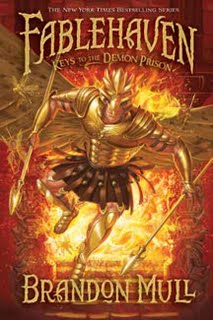
Fablehaven: Keys to the Demon Prison
In March, my family began the epic project of reading out loud the entire Fablehaven series by Brandon Mull. Sounds like we're some kind of awesome people, doesn't it? It wasn't intentional at first. The final book of the series came out in March and my husband bought it the day it came out. He brought it home and put it on the table to tempt me. I knew we'd have to do some negotiating about who would get to read it first, but he was going out of town soon, so I figured I could read it first and then he could take it with him when he left town. Then he suggested we read it out loud to each other so we could enjoy it simultaneously. I pointed out that he was going out of town and it didn't sound like any fun to be reading it over the phone or webcam. He teased that he was just going to take it out of town with him anyway and leave me hanging. Har har. Then he suggested we read the entire series and then culminate with the fifth book. I grumbled. He upped the requirements by suggesting that we read the entire series as a family. I grumbled some more, but mostly for show because it sounded like fun. My oldest had read the first book, but no more. We'd get to enjoy the series again through our kids, which was a worthy project. I agreed and we began.
Nearly every evening for more than three months we read. Mostly it was one chapter at a time but we'd fit in two chapters when we could. Nobody wanted to miss out so we had our bed full of kiddos while we read. Good thing we bought a king-sized bed last year or there's no way all six of us would have fit. My three-year-old would lose patience on occasion, but that wasn't until the later books when the plot got more complex. We would placate her by reading a stack of picture books before we began. One of my favorite parts was how my kids would talk about nothing else when an exciting part happened. Or maybe it's when they would laugh over and over again when Seth was up to his antics. Or maybe it's when they were absolutely entranced while we read to the point of hypnotism. Or maybe it's when my oldest would exclaim every single night, "I can't stand cliffhangers! Please read another chapter!"
By the time we got to the final book, it felt a bit like when the seventh Harry Potter came out. The anticipation and build up for this culminating event was palpable. We were all dying to find out what was going to happen. We went on a trip out of the state at the same time we started it and I read sometimes four chapters a day while we drove or had down time. When we reached the last ten chapters, I would read sometimes for an hour. My husband had strep throat so I was doing all the reading. It was worth it.
I've blogged about this series so many times, I'm not going to bother adding a link here. Just put in the search box the word "Fablehaven" and see how many posts show up. There's a bunch. I have enjoyed this series each step along the way. My only complaint is that the language some of the adults use seems forced. Nobody really talks like that unless they're trying to sound intellectual. On the flip side, Mull has got Seth and Kendra down pat. He knows exactly how to write a kid's voice. Plus, Seth and Kendra have a completely believable sibling relationship. Since they are the focus of the book, it is a treat that he wrote them so perfectly. And enjoyably.
I don't know exactly what to write about the final book, Keys to the Demon Prison. If you haven't read any of the previous books, nothing I write would make any sense. I think you'd have better luck reading previous posts to see if it's the kind of book you'd be interested in for yourself or a kid you know. I will say that it delivered on every count and that it ended exactly how I hoped it would, but better because Brandon Mull has a better imagination than me. I will also say that if you like Harry Potter, you'll like Fablehaven. Harry Potter comparisons get old and are kind of ridiculous, but I'm comparing them in the sense that both series appeal to any age of reader. Unless you hate fantasy books, which just makes me sad.
Brandon Mull is coming out with a new series next year called The Beyonders. I think it's safe to say that we'll be reading it at our house. We'll have to read Mull's The Candy Shop War in the mean time to sate our need for his amazing writing.
Monday, June 28, 2010
The post where I preach about the virtues of graphic novels
I have recently discovered some amazing graphic novels. First off, let me explain what a graphic novel is for any Red Hot Eyebrows readers who are wondering what it is I'm talking about. The word graphic is being used in the sense that it is a novel told in pictures, not graphic as in a graphic nature. It's also a term for comic books, but honestly, the graphic novels I've read don't bear much resemblance to comic books, so having a whole different word makes sense to me.
In the past, I've reviewed some graphic novels without realizing what a big deal they are. I mean, the term graphic novel didn't exist in my vocabulary until a couple of years ago, so I wouldn't have known that, for instance, The Invention of Hugo Cabret, could be considered one. It won the Caldecott award recently for the best picture book of the year. Can you imagine a comic book receiving the same honor? Not me, but much of Hugo Cabret is told in pictures, which is a defining characteristic of graphic novels and also of comic books. So what makes them different from each other? Good question, Jenny. Thank you, I thought so too.
Comic books and graphic novels share some qualities but differ in other ways. Graphic novels are longer, are more in a book format than a thinner magazine format, are more accepted by librarians as acceptable literature, and are sometimes based on already familiar stories. Moms around the world get more warm fuzzies if their child is reading graphic novels versus reading comic books. Honestly, I'd take a graphic novel over a comic book any day, but that's because the nature of comic books is to never have closure, to continually keep the reader buying new installments. It's the boy's version of soap operas. That's a turn off for me. Graphic novels tell stories that don't require the reader to have read the last 20 years worth of comics. That's a big appeal for me.
I always pictured comic books as something nerdy adolescent boys perused in dimly lit shops run by men chasing their own adolescence, wearing t-shirts with obscure slogans on them and bemoaning their inability to move out of their parents' houses. Whew, that was harsh, but forgive me while I eventually get to my point. Comic book collecting is a profitable business and good golly, there are enough movies made out of comic book stories to make Stan Lee a rich man many times over. Obviously there's a demand. So what if it's stories based on aliens and superheroes and villains and mutations and whatever? I happen to like that sort of stuff, but it's a universal fact that parents and teachers have been scorning comic books since the first caveman drew his first flying boy on his cave wall. "Put that burnt stick down and quick making up those stupid flying caveboy stories!" his mom would cry. "Why can't you make nice drawings like your brother, with buffalo and fire and real things?" And thus the first comic book nerd was born.
What's interesting to me is that reluctant readers are known to devour graphic novels, yet there are still parents and teachers who still discourage kids from reading them. Now, I'm not talking about graphic novels that are not intended for children. There's plenty of graphic graphic novels out there. I'm talking about graphic novels, or comic books for that matter, that are written for kids. I can't believe that there are adults out there that would discourage children from reading. Who cares if they'd rather read Pride and Prejudice the graphic novel versus the original? They're reading, for cryin' in the mud! Hook 'em, reel 'em in and then get them tackling Mark Twain!
Luckily, I've only encountered really good graphic novels so far. Shannon and Dean Hale did an excellent job with Rapunzel's Revenge and its sequel Calamity Jack. The stories were exciting and the voice of the narrators witty, funny and interesting. Nathan Hale (no relation to Shannon and Dean) did an excellent job with the illustrations and he kept the story constantly moving. Shannon Hale has proven herself amazing at telling her own version of familiar stories and these books are no exception. I found myself glued to the pages, absorbed in the story and the visual treat it was to read. I had these books at my house for over a month, waiting for me to get around to reading them for this blog post. My kids must have read them a dozen times at least, including my five-year-old who isn't a proficient reader yet. She was drawn into the stories just from the pictures. These books are great for the eight and up crowd, due to some scary critters and very slight romantic elements, but you'll know your own kids best. Tying in the already familiar stories of Rapunzel and Jack and the Beanstalk made these great graphic novels for younger kids and I highly recommend them. Heck, I recommend them for adult readers. They're that awesome.
The next graphic novel was something different. Eric Shanower retold The Wonderful Wizard of Oz as L. Frank Baum wrote it, not like the Hollywood version most people know best. My kids and I read the original Baum book a few years ago so they already knew what to expect. Skottie Young's illustrations were way scarier than those of Nathan Hale, so I wish I had taken more time to carefully look it over before my kids got a hold of it. Regardless, my older kids read the book at least three or four times each before we returned it to the library. It was suspenseful and exciting. The storytelling seemed a bit forced to me, but it didn't deter my kids one bit.
If you're already a graphic novel convert then I'm preaching to the choir. If you've looked down on the genre, I hope I've shown you a different angle or convinced you to give them a try. I've certainly enjoyed myself with the ones I've found and I hope to add a few more to my list. I'll try not to skulk about in darkened stores with the other nerds too much in the mean time.
In the past, I've reviewed some graphic novels without realizing what a big deal they are. I mean, the term graphic novel didn't exist in my vocabulary until a couple of years ago, so I wouldn't have known that, for instance, The Invention of Hugo Cabret, could be considered one. It won the Caldecott award recently for the best picture book of the year. Can you imagine a comic book receiving the same honor? Not me, but much of Hugo Cabret is told in pictures, which is a defining characteristic of graphic novels and also of comic books. So what makes them different from each other? Good question, Jenny. Thank you, I thought so too.
Comic books and graphic novels share some qualities but differ in other ways. Graphic novels are longer, are more in a book format than a thinner magazine format, are more accepted by librarians as acceptable literature, and are sometimes based on already familiar stories. Moms around the world get more warm fuzzies if their child is reading graphic novels versus reading comic books. Honestly, I'd take a graphic novel over a comic book any day, but that's because the nature of comic books is to never have closure, to continually keep the reader buying new installments. It's the boy's version of soap operas. That's a turn off for me. Graphic novels tell stories that don't require the reader to have read the last 20 years worth of comics. That's a big appeal for me.
I always pictured comic books as something nerdy adolescent boys perused in dimly lit shops run by men chasing their own adolescence, wearing t-shirts with obscure slogans on them and bemoaning their inability to move out of their parents' houses. Whew, that was harsh, but forgive me while I eventually get to my point. Comic book collecting is a profitable business and good golly, there are enough movies made out of comic book stories to make Stan Lee a rich man many times over. Obviously there's a demand. So what if it's stories based on aliens and superheroes and villains and mutations and whatever? I happen to like that sort of stuff, but it's a universal fact that parents and teachers have been scorning comic books since the first caveman drew his first flying boy on his cave wall. "Put that burnt stick down and quick making up those stupid flying caveboy stories!" his mom would cry. "Why can't you make nice drawings like your brother, with buffalo and fire and real things?" And thus the first comic book nerd was born.
What's interesting to me is that reluctant readers are known to devour graphic novels, yet there are still parents and teachers who still discourage kids from reading them. Now, I'm not talking about graphic novels that are not intended for children. There's plenty of graphic graphic novels out there. I'm talking about graphic novels, or comic books for that matter, that are written for kids. I can't believe that there are adults out there that would discourage children from reading. Who cares if they'd rather read Pride and Prejudice the graphic novel versus the original? They're reading, for cryin' in the mud! Hook 'em, reel 'em in and then get them tackling Mark Twain!
Luckily, I've only encountered really good graphic novels so far. Shannon and Dean Hale did an excellent job with Rapunzel's Revenge and its sequel Calamity Jack. The stories were exciting and the voice of the narrators witty, funny and interesting. Nathan Hale (no relation to Shannon and Dean) did an excellent job with the illustrations and he kept the story constantly moving. Shannon Hale has proven herself amazing at telling her own version of familiar stories and these books are no exception. I found myself glued to the pages, absorbed in the story and the visual treat it was to read. I had these books at my house for over a month, waiting for me to get around to reading them for this blog post. My kids must have read them a dozen times at least, including my five-year-old who isn't a proficient reader yet. She was drawn into the stories just from the pictures. These books are great for the eight and up crowd, due to some scary critters and very slight romantic elements, but you'll know your own kids best. Tying in the already familiar stories of Rapunzel and Jack and the Beanstalk made these great graphic novels for younger kids and I highly recommend them. Heck, I recommend them for adult readers. They're that awesome.The next graphic novel was something different. Eric Shanower retold The Wonderful Wizard of Oz as L. Frank Baum wrote it, not like the Hollywood version most people know best. My kids and I read the original Baum book a few years ago so they already knew what to expect. Skottie Young's illustrations were way scarier than those of Nathan Hale, so I wish I had taken more time to carefully look it over before my kids got a hold of it. Regardless, my older kids read the book at least three or four times each before we returned it to the library. It was suspenseful and exciting. The storytelling seemed a bit forced to me, but it didn't deter my kids one bit.
If you're already a graphic novel convert then I'm preaching to the choir. If you've looked down on the genre, I hope I've shown you a different angle or convinced you to give them a try. I've certainly enjoyed myself with the ones I've found and I hope to add a few more to my list. I'll try not to skulk about in darkened stores with the other nerds too much in the mean time.
Wednesday, June 16, 2010
The Red Pyramid
Not that long ago, Caren was raving about The Lightning Thief and I remembered how much I had enjoyed reading it as well. I need to finish reading the series, but it's a bit of a project when there's seventy kazillion people on the wait list for it at the library. Anyway, one day at the library I bumped into my friend Katie and her kids. I love talking with her because our conversations usually include book swapping ideas and author comparisons. I love to talk me some book talk. She grabbed my oldest daughter and marched her over to where there was a copy of the newest Rick Riordan book, The Red Pyramid. It's the beginning of a new series based on Egyptian myths and looked like a lot of fun. Sure enough, my daughter devoured it and rushed it to me with the command to read immediately. I usually do as I'm told, so I gave it a read.
Riordan is tackling Egyptian gods and myths in this new series and instead of our heroes, siblings Carter and Sadie, being descended from gods, like in The Lightning Thief, they are descended from pharaohs. In ancient times, the gods would inhabit certain people with noble enough blood to accomplish their desires and plans in the world. The gods inhabit the Duat, sort of a parallel existence. There's some good guys and bad guys and through an accident involving the Rosetta Stone, both good and bad are on the loose. Honestly, there was a whole lot to this that I had no idea about, having never studied ancient Egypt. My whole database of knowledge comes from watching The Mummy. Sad. After reading this book, it made me want to check out some books on Egyptian mythology and history to see what else I'm missing out on. Or I'll just read the series and get a hefty fictional dose. That sounds good too.
I had an epiphany while reading this book. The reason why Rick Riordan is making enough money to use it as toilet paper is because he speaks to the most innate desire of any child: to wake up one day and discover that you're actually a superhero/princess/supernatural being. Who didn't pretend to be able to fly or fight off powerful enemies or rule a nation or be wicked smart when you were a kid? Riordan's books are about kids who discover that they are so much more than they seem. Children of gods or descended from royalty who are given tremendous power and abilities is a pretty appealing story. Wish I had thought of it.
The Red Pyramid was a fun ride and it kept me turning pages. My only complaint would be that Riordan sure knows how to write a boy, but he could use some lessons on how to write a girl's thoughts, feelings and actions. I'm sure he wanted Sadie to come across as sassy, but I mostly thought she was a caricature of a sassy girl. Like he was thinking, "I bet a sassy girl would say this! Oh yeah!" Oh well, Carter is a delight to read about so I got over Sadie's issues. Now that my husband has read it as well, we can return it to the library and let some other kid escape into a world where evil must be vanquished and only preteens are capable of doing it.
Thursday, May 13, 2010
The Top 100 Picture Books
Since so many of you enjoyed the post about the top 100 children's novels, I thought I would do some digging and present the top 100 picture books list from 2009. There were a whole pile of books I didn't recognize in this list, though the top 15 were all ones I have read or own. Here are the books that didn't make the list, in case you were curious. I would do some major shuffling, eliminating and adding to this particular list. I didn't disagree nearly as strongly with the novel list. Why is that, I wonder? Hmmm.
You might notice that I haven't blogged about anything I've read lately. That's because I'm in the midst of RCPP season. That would be Recitals, Concerts, Presentations, and Projects. Oy. I'm sick of school and it's not even me who's going. Caren's excuse is a new baby. Congrats to her! Now spend some of those wee hours reading, wouldya? It'll make me look less lazy. Ha ha, I jest. Sorta.
Thursday, May 6, 2010
The Top 100 Children's Novels
Recently I found myself eagerly checking the School Library Journal's blog every single day. They had called for librarians, writers, readers and all who were interested to rate their top ten children's novels of all time. There was a system of how many points a book got according to its placement on each person's list. I'm glad I'm not the one who had to figure it all out, instead I just got to read and enjoy. Now I'm going to make it even easier on you and tell you to click here to see the complete list.
I was delighted to find that the list split equally among books I'd never read or never heard of, books I love and cherish and own, and books I remember reading at some point but don't own. I would have shuffled some of the order of the books to suit my preferences, but in general it was pretty close to what I consider the best. I've put some of the books I'd like to own on my Amazon wish list and will now have Christmas present ideas for a few years.
If ever you find yourself in need of a good book for you or your kids to read, hop over to the list and see what might fit. I might have my kids work their way through the list over the summer, now that I think about it. Maybe I will too.
Monday, April 12, 2010
Haven Kimmel's books for children
If I ever get to meet Haven Kimmel, I already know what I will ask her. "How do you manage to tell such sad stories with humor and beauty? Huh? HUH?!" I'll try not to grab her by the shoulders and shake really hard. Seriously, it is amazing to me and maybe if I shake her hard enough something will pop out of her brain and I can steal it and write my own beautiful book. It would be worth the restraining order she'd inevitably put on me. Caren and I are huge fans of Haven Kimmel's books, which is evidenced here, here, here, here, and here. I'm starting to think I should just write a blog post that says, "Read a new Haven Kimmel book, you should read it too" and leave it at that. But no, I will wax long and enthusiastically on every new book she writes. Get used to it.
I discovered recently that Kimmel had written two books for younger readers, so of course I had to read them. The first is a picture book called Orville: A Dog Story and was actually written in 2003, so it's been out for a while. It tells the story of Orville, a dog who's had a sad life of being mistreated and shuffled from one owner to another. He ends up with a farmer and his wife, who clean him up and use him as a watchdog, but don't really love him. It doesn't help that he's ugly, huge, wild and barks constantly. The poor thing barks because he's so miserable. See what I mean? Sad story. Well, Orville sees a woman move in next door and he falls in love. He breaks his chain, gets into Sally's house and watches over her while she sleeps. She wakes up shocked to find a huge ugly dog in her living room and calls the fire department. Orville is dragged back home by the farmer only to break free again and go back to Sally's house. This happens several times before a firefighter makes the observation that maybe the dog loves her. The only thing that could have made this book perfect is better illustrations. I didn't care for the watercolors that left out so much detail and looked sloppily done. Other than that, it was a beautiful book. It's a tale of heart-rending loneliness, of neglect and loss. But it's also a tale of love and joy. Geared towards children, it's not too sad but just enough for me to have a good talk with my kids about that poor sad dog and why he was now happy.
The second book was Kaline Klattermaster's Treehouse and was written a few years ago. It's a juvenile fiction book, so about 150 pages and great for a 2nd or 3rd grader to read. It would also make an excellent read-aloud book, but I'm getting ahead of myself. Kaline Klattermaster is an odd little seven-year-old boy who doesn't understand why he can't play his imaginary bugle at school, dig holes in his yard and then cover them up with grass for someone to fall into, explore his strange neighbor's basement, or figure out where his father has disappeared to. His father always made sure to set the timer for his bath, brushing his teeth and other activities that need regulation. Things with his father are always very orderly, giving the reader the distinct impression that this guy has a serious case of obsessive compulsive disorder. Kaline's mother is not nearly as orderly, driving on the grass and making Kaline eat a chicken leg for breakfast after forgetting to wake him up in time for school. Nothing like his father. In defense of the bullies at school and his no longer orderly household, Kaline imagines up two big brothers, who also happen to be in the third grade, and an enormous treehouse to play in. It keeps him safe and helps him cope with the fact that he doesn't know where his father has gone.
Doesn't that sound like a sad story? Then let me tell you that I laughed out loud over and over and over again reading this book. I laughed until I thought I would get a stitch in my side. Kaline has the best imagination I have ever read about. My oldest daughter and I read it and quoted it to each other and laughed over it and talked about it and read it again. I could own this book. When my daughter had her birthday, she'd convinced herself I was giving her a copy of Kaline Klattermaster and was sorely disappointed that she got Nancy Drew instead. This book was a treasure and despite the fact that it's dealing with separated parents, a little boy lost and confused, and nasty school bullies, you can't help feeling lighter after reading it.
How does she do it? How can Haven Kimmel take such sad circumstances and make you laugh out loud over them? Like in A Girl Named Zippy, she doesn't mope or generate pity for less than ideal circumstances, and in some cases really horrible situations, but instead finds reasons to laugh. Not all her books are like that. Oh my goodness, Iodine was not funny in the least, nor some of her other books, but when she aims to create humor, she does it splendidly.
Monday, March 22, 2010
Love That Dog, Hate That Cat
Poetry isn't always the easiest thing to teach to kids. Heck, it isn't always the easiest thing to teach to adults either. Most people can easily enjoy simple rhymes and clear word pictures, but anything slightly more abstract is harder to grasp. Shannon Creech took this concept, the challenge of learning poetry, and turned it into two books of freestyle verse about a boy, Jack, and his exposure to poetry. Love that Dog is the first book and takes the reader through the process of watching Jack learn to enjoy and write his own poetry. His teacher, Miss Stretchberry, knows her stuff and doesn't coddle her students with easy poetry like Jack Prelutsky or Shel Silverstein. Not that enjoying those poets is a bad thing, but it's much harder to grasp William Carlos Williams when you're only ten years old, like Jack is.
Told in freestyle verse in the forms of notes to his teacher, Jack goes from hesitant and suspicious of this poetry business, to finding his own voice and expression. He decides to emulate the poet Walter Dean Myers and make a poem about his beloved dog, Sky. The reader gets hints about Jack's dog and his tenderness towards him, but not the whole story of what happened to the dog until later in the book. When I finally reached the end where Jack presents his poem about Sky, I burst into tears. Creech does an amazing job of guiding us through Jack's process in expressing his love for his dog and by the time you reach that poem, you ache for that little boy and his loss. It was a beautiful book. It reminded me of all the poems I learned about in the course of my public school education and how much they meant to me when I learned to understand them. The book is a fast read, but would be great as a read-aloud as a family. At the end of the book, Creech includes the poems that Miss Stretchberry taught to her class and that would a great starting point in discussing poetry to kids. It's on my list of books to read to my kids.
In Hate That Cat, Jack is back at school the next year and learning more poetry. It's more of the same, but not redundant. The reader gets to learn more about Jack's family and their new addition. You get to read a bit more about his stubborn Uncle Bill who believes that all poetry must have meter and rhyme. What a stick-in-the-mud. It wasn't as moving as Love That Dog, but I still enjoyed it and would definitely read that to my kids right after the first.
This is a great way to expose kids to non-rhyming, freestyle and more abstract poetry. After all, if you start young it only gets easier with time. Next, I'll be convincing you all to start playing opera to your family. Seriously, it's awesome. I'll find a way to get everybody hooked one of these days.
Monday, December 28, 2009
Unblogged books
I admit, I like things to be tidied up. I like my loose ends tied. Here we are, nearing the end of the year and I have a handful of books I never blogged about but they won't stop nagging at me because of it. I deemed each of them unworthy and yet, here I am blogging about them. Darn those unbloggable books. You might be wondering, what makes a book unworthy of me sharing my opinion willy-nilly? Mostly it was because I couldn't think of anything spectacular to say that would either deter readers or cause them to leap from their computers and dash to the library. Those are the two reactions I prefer to instill in people. Some of these I loved and some I hated, but the most I can conjure up is about a paragraph each.

I read one book this year that I so completely disliked that I didn't even want to think about it after I read it. Usually, if I really don't like a book it's just that much more fuel for my fire. But this book was repulsive to me and I didn't want to think about it ever again after I read it. My Abandonment by Peter Rock is about a girl, Caroline, and her father who are living in a state park in Oregon, off the grid and avoiding people. Their past is mysterious and you gather that the father is a veteran with mental illness. They do get discovered and people try to help them in their situation, but everything just deteriorates more and more. It's based on a true story but the whole thing made my skin crawl. That's all I want to say about that.

Mark L. Van Name's newest installment of his books about Jon Moore and his intelligent ship Lobo is just as awesome as I thought it would be. If my blogging about the previous books haven't gotten you to pick up a copy of the first book yet, me writing yet another blog about it probably won't do the trick. Overthrowing Heaven is more action, more great sci-fi and focused much more on Lobo than Jon. Loved it.

When I was at my uncle's funeral, I met the father of an upcoming author, Aprilynne Pike. It's a long story, but I decided to read her young adult novel, Wings. It's about a girl who suddenly sprouts a blossom out of her back that resembles wings. Ends up, she's a faerie and never knew it. This story could have been very cool and original and yet, it just reads like a Twilight knock-off, love triangle and everything. Except in Wings it's the girl who's supernatural, not her love interests. Well, one of them is, but whatever. If you love Twilight, read Wings, but I can't endorse it much more than that.
Caren went to a midnight release party for The Gathering Storm by Brandon Sanderson and Robert Jordan and didn't know what the hubub was about. My husband was seething with
jealousy that she went and had pre-ordered a signed copy of the book months before. Caren sent us the bumper sticker she got at the party that said, "Bela is a Darkfriend" and my husband giggled like a schoolgirl and then dashed upstairs to plaster it to his bookcase. The fact is, if you're already a fan of Robert Jordan's Wheel of Time series, you'll have read the latest installment finished by Sanderson after Jordan passed away. You don't need me telling you how awesome it is or how perfectly Sanderson accomplished the task of taking over this epic book series. You already know. And those of you who don't know probably would be hesitant to start a series that includes twelve books, one prequel and a nearly rabid fan base. I don't blame you.

I like fairy tale retellings, like Shannon Hale's The Goose Girl or Gail Carson Levine's Ella Enchanted. They're fun and interesting and flesh out a tale so creatively that it gives it new life. Princess of the Midnight Ball by Jessica Day George falls directly into that category and the caliber of Hale or Levine. George retells the tale of the twelve dancing princesses, which was one my favorite stories growing up. It was riveting and exciting and very well done. I read it, then passed it on to both my eight- and six-year-old daughters who both adored it. I would gander that any child on a skilled enough reading level would love this book and would also be a great read-a-loud. I'm going to have to do some more reading of George's books if this is what I have to expect. Excellent stuff.

Speaking of excellent writing, I recently re-read The House of the Scorpion by Nancy Farmer. This book is a perfectly crafted dystopian future story about a tyrannical drug lord, cloning, and corrupt governments, but written for the young adult age group. Nancy Farmer has written many books but Scorpion has to be my favorite. Matteo, the clone of drug lord Matteo Alacran of the nation of Opium, a strip of land between Mexico and the U.S. is just as clever as his original version and with the help of some other clever people is able to make more of his life than as spare parts. Very cool, very exciting and some interesting deep thinking about the idea of cloning in general and the value of life.
Ahh, I'm feeling better. Now I can dive into books for the new year knowing that I tidied up my pile. Now if only I felt that way about my desk...

I read one book this year that I so completely disliked that I didn't even want to think about it after I read it. Usually, if I really don't like a book it's just that much more fuel for my fire. But this book was repulsive to me and I didn't want to think about it ever again after I read it. My Abandonment by Peter Rock is about a girl, Caroline, and her father who are living in a state park in Oregon, off the grid and avoiding people. Their past is mysterious and you gather that the father is a veteran with mental illness. They do get discovered and people try to help them in their situation, but everything just deteriorates more and more. It's based on a true story but the whole thing made my skin crawl. That's all I want to say about that.

Mark L. Van Name's newest installment of his books about Jon Moore and his intelligent ship Lobo is just as awesome as I thought it would be. If my blogging about the previous books haven't gotten you to pick up a copy of the first book yet, me writing yet another blog about it probably won't do the trick. Overthrowing Heaven is more action, more great sci-fi and focused much more on Lobo than Jon. Loved it.

When I was at my uncle's funeral, I met the father of an upcoming author, Aprilynne Pike. It's a long story, but I decided to read her young adult novel, Wings. It's about a girl who suddenly sprouts a blossom out of her back that resembles wings. Ends up, she's a faerie and never knew it. This story could have been very cool and original and yet, it just reads like a Twilight knock-off, love triangle and everything. Except in Wings it's the girl who's supernatural, not her love interests. Well, one of them is, but whatever. If you love Twilight, read Wings, but I can't endorse it much more than that.
Caren went to a midnight release party for The Gathering Storm by Brandon Sanderson and Robert Jordan and didn't know what the hubub was about. My husband was seething with
jealousy that she went and had pre-ordered a signed copy of the book months before. Caren sent us the bumper sticker she got at the party that said, "Bela is a Darkfriend" and my husband giggled like a schoolgirl and then dashed upstairs to plaster it to his bookcase. The fact is, if you're already a fan of Robert Jordan's Wheel of Time series, you'll have read the latest installment finished by Sanderson after Jordan passed away. You don't need me telling you how awesome it is or how perfectly Sanderson accomplished the task of taking over this epic book series. You already know. And those of you who don't know probably would be hesitant to start a series that includes twelve books, one prequel and a nearly rabid fan base. I don't blame you.
I like fairy tale retellings, like Shannon Hale's The Goose Girl or Gail Carson Levine's Ella Enchanted. They're fun and interesting and flesh out a tale so creatively that it gives it new life. Princess of the Midnight Ball by Jessica Day George falls directly into that category and the caliber of Hale or Levine. George retells the tale of the twelve dancing princesses, which was one my favorite stories growing up. It was riveting and exciting and very well done. I read it, then passed it on to both my eight- and six-year-old daughters who both adored it. I would gander that any child on a skilled enough reading level would love this book and would also be a great read-a-loud. I'm going to have to do some more reading of George's books if this is what I have to expect. Excellent stuff.

Speaking of excellent writing, I recently re-read The House of the Scorpion by Nancy Farmer. This book is a perfectly crafted dystopian future story about a tyrannical drug lord, cloning, and corrupt governments, but written for the young adult age group. Nancy Farmer has written many books but Scorpion has to be my favorite. Matteo, the clone of drug lord Matteo Alacran of the nation of Opium, a strip of land between Mexico and the U.S. is just as clever as his original version and with the help of some other clever people is able to make more of his life than as spare parts. Very cool, very exciting and some interesting deep thinking about the idea of cloning in general and the value of life.
Ahh, I'm feeling better. Now I can dive into books for the new year knowing that I tidied up my pile. Now if only I felt that way about my desk...
Labels:
Bibliojunk,
Fantasy,
Fiction,
Kids,
Science Fiction,
Young Adult
Wednesday, December 23, 2009
Al Capone in a new light
I think that there is a justifiable fascination with Alcatraz. I remember when the magician David Copperfield escaped from Alcatraz on national television, back when he did those t.v. specials that had my entire family riveted. Okay, so it's an illusion, but it was very cool. The tales of Th
e Rock and its inmates make for great stories and when my husband and I made a trip to San Francisco several years ago, touring the island was at the top of my agenda. It didn't disappoint. You could imagine these men, the worst criminals of their time, locked away with no hope of escape, the surrounding ocean full of dangers and the guards on watch at all times. What I didn't realize is that the families of the guards and workers lived on the island with them. The history behind that is very interesting and Gennifer Choldenko explores it in her two books, Al Capone Does My Shirts and Al Capone Shines My Shoes.Matthew Flanagan a.k.a. Moose and his family have come to Alcatraz for his father to work there as an electrician and guard, and also to be close to a nearby school for his sister who has autism. It takes place in 1935, which was before autism was labeled as such, but I quickly figured out that is what is going on with Natalie. That time period is also when Al Capone was an inmate of Alcatraz and the whole world seemed fascinated by this fact. When Moose and his family arrive, the warden is quick to inform him of how fast his dad will get fired if Moose is caught ever talking about Capone to anybody, ever. Moose also becomes acquainted with the warden's daughter, Piper, who is both beautiful and devious and manipulative. There are other kids on the island which make for a fun ensemble. Jimmy and his sister Theresa who are loyal friends and good to Natalie, Annie the girl who plays baseball as good as a boy, and a few others.
Moose makes a friend at school, a boy named Scout, who is as equally obsessed with baseball as Moose is. A highly coveted item is a baseball retrieved from where the inmates play and Scout begs for Moose to get one for him. Trouble is, those balls are hard to come by since the inmates do their best to not let them get over the wall of the yard. Moose tries his best to find a ball, but with Natalie in tow, it's hard to look and keep an eye on her. When he discovers a small hole in the outer fence, he has better luck looking but that is asking for trouble.
Most of the kids are accepting of Natalie, except for Piper, but the adults are another matter. Moose's parents are anxious to get her into this school, but they deem her too old and unmanageable. She starts working with a local woman to try and re-accepted to the school and makes some progress. It grated on my nerves the way people treat Natalie and their family, but it is probably accurate. It's not socially acceptable to make rude comments about a person with disabilities now, but back then people probably considered it their right to tell somebody to ship their kid off to an asylum.
The second book follows right behind the first and has Moose come into direct contact with Al Capone, along with some other inmates. The story behind the titles of the books is that the inmates did the laundry of the families on the island, if the families took up that opportunity. The warden also had them doing plumbing, some cooking and also serving at parties. These inmates, considered to not be flight risks because of how close they were to finishing up their sentences, were called passmen. It surprised me how much time the kids were around these men, considering they were in the country's most secure prison for a reason. Choldenko makes her facts pretty accurate and even includes an appendix with references from books and interviews that she did.
I thought both books were fascinating and thoroughly enjoyable reading. Choldenko's storytelling was detailed, fun and interesting. You can't help but love Moose with his big heart and conflicting feelings about Natalie, Piper, Annie and Scout. And Al Capone for that matter. The man has unmistakable charisma and Moose can't help but get caught up in it, but be afraid of it at the same time. I had to keep reminding myself that Capone was a hardened criminal, a crime boss and murderer, no matter what favors he carefully doled out. The ending of Al Capone Shines My Shoes was awesome and Natalie proves to be a hero to the other kids. Great reading for you and any kids in your house that would have an interest.
Monday, December 21, 2009
The City of Ember series
I enjoy some post-apocalyptic fiction when I can get some, same as any other mommy in her 30s with a pack of kids and a penchant for reading. But sometimes I'd like something a bit less gritty than Cormac McCarthy's The Road or even Suzanne Collins's Hunger Games series. If you ever find yourself in the same boat, then Jeanne DuPrau's The City of Ember series is the one for you. Do I sound like an infomercial yet?
Let's break it down. The first book, The City of Ember, takes place in a city far below the earth's
surface. The reader catches on quickly that the city is underground but the inhabitants have no idea that the world could be anything different than dark and cold and dependent on electricity for light. They've been down there for over 250 years, at least 50 years longer than the original Builders had in mind when they created the city and sent people down there to live after the Disaster that destroyed the surface. Lina Mayfleet and Doon Harrow are the heroes of our story, young people who realize that their mayor is corrupt, that the generator that keeps everyone with light and heat is dying, and that a mysterious message from the past will lead them out of Ember. To where, they have no idea. They don't even know what out of Ember could possibly be like. They follow and hunt down clues, deal with adults who help and hinder, and have some truly heart-pounding moments where the reader has to wonder if they will ever leave Ember. The book is geared towards tween readers, meaning 9-12 year olds, depending on reading ability and interest. For me, it was a fast, easy but intense read. Loved it.
The second installment, The People of Sparks picks up where The City of Ember leaves off, like a mere second later. I don't know how to talk about this book without spoiling the first, but let's say that Lina and Doon have a new set of challenges and new cultures to adapt to. It was interesting and compelling, but a bit heavy-handed. There is a huge message of non-violence and the consequences of bigotry and mob mentality, which would be interesting to discuss with a younger reader. I found it interesting, but not as exciting as the first book. Then again, how often do you encounter a book that addresses these topics in a way for a tween to understand it?
The third installment is actually a prequel to The City of Ember, called The Prophet of Yonwood. It takes place mid-21st century in North Carolina where a woman has seen a vision of the future and it is desolate and destroyed. She becomes
semi-comatose and her incoherent ramblings are interpreted by a Bible-thumping, militaristic woman named Mrs. Beeson, who twists the words into whatever serves her own agenda. Dissenters are punished severely. Eleven-year-old Nickie and her aunt come to town to deal with the mansion that Nickie's great-grandfather has left behind at his death. Nickie is fascinated by the town and its inhabitants, but soon falls victim to the machinations of Mrs. Beeson. She slowly begins to see that blindly following beliefs of those around her is not the way to make the world a better place. Again we see this message about mob mentality, blindly following the crowd and intolerance. I found this book to be the slowest read of them all, since it's mostly Nickie dealing with the situation she's in. Not until the very last chapter did I feel like I knew what the purpose of this installment was, despite DuPrau's message of non-violence and independent thinking. It's probably my least favorite and since it doesn't conclusively explain the events that lead to the Disaster and the settlement of Ember, it doesn't really feel necessary. I'm waiting for my daughter to finish reading it so I can pick her brain about what she thought of it.
The fourth, and final, installment was The Diamond of Darkhold and here we get back to some of the action and compelling story-telling of the first book. We're back to Lina and Doon and their desperate attempt to help the citizens of Ember, which leads them to a ruined city with a tyrannical patriarch waiting to capture anyone who crosses his path. It had the same excitement as the first book and not nearly the preachy overtones of the second and third books. Not that books shouldn't have a message, but I wonder if she could have integrated these messages into the other stories instead of writing two books full of morality lessons. We finally get a firm resolution to the series in this book and it feels right and complete. The most horrifying aspect of the book is some people's nonchalance towards the value of books, often burning them for firewood. Gave me chills. Doon and Lina plead with these people to stop but they can't read and see no need for it, so why not? If ever I find myself in a post-apocalyptic world and desperate for firewood, heaven help me if I start burning books.
The series as a whole was interesting and a different take on mere survival in a desolate world. It was about friendship and tolerance, problem solving and independent thinking, non-violence and humanity and other aspects of building a functioning society. Pretty hefty topics for the age demographic DuPrau was aiming at, but even when I thought it was a bit preachy, it didn't feel unapproachable and incomprehensible to your average twelve-year-old. That's impressive, I think. Maybe we can save those kids from reading Lord of the Flies or some other such horrifying book and try this series instead.
Let's break it down. The first book, The City of Ember, takes place in a city far below the earth's
surface. The reader catches on quickly that the city is underground but the inhabitants have no idea that the world could be anything different than dark and cold and dependent on electricity for light. They've been down there for over 250 years, at least 50 years longer than the original Builders had in mind when they created the city and sent people down there to live after the Disaster that destroyed the surface. Lina Mayfleet and Doon Harrow are the heroes of our story, young people who realize that their mayor is corrupt, that the generator that keeps everyone with light and heat is dying, and that a mysterious message from the past will lead them out of Ember. To where, they have no idea. They don't even know what out of Ember could possibly be like. They follow and hunt down clues, deal with adults who help and hinder, and have some truly heart-pounding moments where the reader has to wonder if they will ever leave Ember. The book is geared towards tween readers, meaning 9-12 year olds, depending on reading ability and interest. For me, it was a fast, easy but intense read. Loved it.
The second installment, The People of Sparks picks up where The City of Ember leaves off, like a mere second later. I don't know how to talk about this book without spoiling the first, but let's say that Lina and Doon have a new set of challenges and new cultures to adapt to. It was interesting and compelling, but a bit heavy-handed. There is a huge message of non-violence and the consequences of bigotry and mob mentality, which would be interesting to discuss with a younger reader. I found it interesting, but not as exciting as the first book. Then again, how often do you encounter a book that addresses these topics in a way for a tween to understand it?The third installment is actually a prequel to The City of Ember, called The Prophet of Yonwood. It takes place mid-21st century in North Carolina where a woman has seen a vision of the future and it is desolate and destroyed. She becomes
semi-comatose and her incoherent ramblings are interpreted by a Bible-thumping, militaristic woman named Mrs. Beeson, who twists the words into whatever serves her own agenda. Dissenters are punished severely. Eleven-year-old Nickie and her aunt come to town to deal with the mansion that Nickie's great-grandfather has left behind at his death. Nickie is fascinated by the town and its inhabitants, but soon falls victim to the machinations of Mrs. Beeson. She slowly begins to see that blindly following beliefs of those around her is not the way to make the world a better place. Again we see this message about mob mentality, blindly following the crowd and intolerance. I found this book to be the slowest read of them all, since it's mostly Nickie dealing with the situation she's in. Not until the very last chapter did I feel like I knew what the purpose of this installment was, despite DuPrau's message of non-violence and independent thinking. It's probably my least favorite and since it doesn't conclusively explain the events that lead to the Disaster and the settlement of Ember, it doesn't really feel necessary. I'm waiting for my daughter to finish reading it so I can pick her brain about what she thought of it.
The fourth, and final, installment was The Diamond of Darkhold and here we get back to some of the action and compelling story-telling of the first book. We're back to Lina and Doon and their desperate attempt to help the citizens of Ember, which leads them to a ruined city with a tyrannical patriarch waiting to capture anyone who crosses his path. It had the same excitement as the first book and not nearly the preachy overtones of the second and third books. Not that books shouldn't have a message, but I wonder if she could have integrated these messages into the other stories instead of writing two books full of morality lessons. We finally get a firm resolution to the series in this book and it feels right and complete. The most horrifying aspect of the book is some people's nonchalance towards the value of books, often burning them for firewood. Gave me chills. Doon and Lina plead with these people to stop but they can't read and see no need for it, so why not? If ever I find myself in a post-apocalyptic world and desperate for firewood, heaven help me if I start burning books.The series as a whole was interesting and a different take on mere survival in a desolate world. It was about friendship and tolerance, problem solving and independent thinking, non-violence and humanity and other aspects of building a functioning society. Pretty hefty topics for the age demographic DuPrau was aiming at, but even when I thought it was a bit preachy, it didn't feel unapproachable and incomprehensible to your average twelve-year-old. That's impressive, I think. Maybe we can save those kids from reading Lord of the Flies or some other such horrifying book and try this series instead.
Monday, November 23, 2009
Benedict, Catching Fire and Alcatraz
Series books are a tricky business. The first book in a series will often feel fresh and interesting and new, but that kind of momentum is hard to maintain through the rest of the series. The typical trilogy formula has the second book in the series be the least interesting. Plot lines have to be displayed, characters have to go through conflict and those books never end happily. The second book is like a holding place for the third book, which you know will be interesting and suspenseful and, ultimately, satisfying, but you got to slug through the second book to get to the third.
I read a bundle of series installments recently and they fell differently on the scale of series
success. The first was The Mysterious Benedict Society and the Prisoner's Dilemma by Trenton Lee Stewart. I've blogged about the first and second books and I stand by my opinion that these are some of the best books I've ever read. The writing is amazing and the plot lines intricate, but not so much that my eight- and six-year-old can't enjoy it. The third book has more of the adventures of Reynie, Sticky, Kate and Constance, but it takes longer to get into the meat of the book. The first part of the book spends quite some time giving you Constance's mysterious background which we've been left in the dark about so far. It was interesting and I was excited to read it, but I grew anxious about when the action would really start. When it did, it was great. This book had more closure than any of the others, which is saying something since I was convinced the first book was the only one. Stewart doesn't leave you hanging at the end of each book which makes it easier to wait for the next one. I'm almost positive this is the last book of that series that Stewart will do, but I would love for him to create another universe for us readers to enjoy.
Next, I read Catching Fire by Suzanne Collins, the second book after The Hunger Games. I
thought that The Hunger Games was fascinating and a great read, but I was disappointed in Catching Fire. It seemed to suffer from second book-itis. Katniss, our heroine, spins her wheels in her hometown, trying to rebel, dealing with her love triangle, waiting for doom to descend--which it does, of course--and the reader has to wait for the action to start. It does start, but only long enough to lead us into a cliffhanger. This book is an example of the frustration of middle books in a series. That said, it's still exciting and the series as a whole will probably be awesome. If I could go back in time and tell myself to wait for all three books to come out, that's what I would do. I would never listen to such advice, but I'd try anyway.
Lastly, I read Alcatraz and the Knights of Crystallia by Brandon Sanderson.
It still has snarky, nonsense-filled narration and action-packed chapters, but it lacked something that I'm going to blame on being the middle book of a series. It's the third installment out of what I suspect will be five books, so it's definitely the middle and lacks some of the momentum and excitement of the first two books. You get a peek into the Freelands of this imaginary world and has some fun moments with the villainous Librarians, but it just wasn't as much fun as the first two. Like Catching Fire, the series as a whole will be great, but we have to wait for it all to come together in the mean time. Not good for instant gratification.
While I'm thinking about it, I would qualify each of these series like this:
I read a bundle of series installments recently and they fell differently on the scale of series
success. The first was The Mysterious Benedict Society and the Prisoner's Dilemma by Trenton Lee Stewart. I've blogged about the first and second books and I stand by my opinion that these are some of the best books I've ever read. The writing is amazing and the plot lines intricate, but not so much that my eight- and six-year-old can't enjoy it. The third book has more of the adventures of Reynie, Sticky, Kate and Constance, but it takes longer to get into the meat of the book. The first part of the book spends quite some time giving you Constance's mysterious background which we've been left in the dark about so far. It was interesting and I was excited to read it, but I grew anxious about when the action would really start. When it did, it was great. This book had more closure than any of the others, which is saying something since I was convinced the first book was the only one. Stewart doesn't leave you hanging at the end of each book which makes it easier to wait for the next one. I'm almost positive this is the last book of that series that Stewart will do, but I would love for him to create another universe for us readers to enjoy.Next, I read Catching Fire by Suzanne Collins, the second book after The Hunger Games. I
thought that The Hunger Games was fascinating and a great read, but I was disappointed in Catching Fire. It seemed to suffer from second book-itis. Katniss, our heroine, spins her wheels in her hometown, trying to rebel, dealing with her love triangle, waiting for doom to descend--which it does, of course--and the reader has to wait for the action to start. It does start, but only long enough to lead us into a cliffhanger. This book is an example of the frustration of middle books in a series. That said, it's still exciting and the series as a whole will probably be awesome. If I could go back in time and tell myself to wait for all three books to come out, that's what I would do. I would never listen to such advice, but I'd try anyway.Lastly, I read Alcatraz and the Knights of Crystallia by Brandon Sanderson.
It still has snarky, nonsense-filled narration and action-packed chapters, but it lacked something that I'm going to blame on being the middle book of a series. It's the third installment out of what I suspect will be five books, so it's definitely the middle and lacks some of the momentum and excitement of the first two books. You get a peek into the Freelands of this imaginary world and has some fun moments with the villainous Librarians, but it just wasn't as much fun as the first two. Like Catching Fire, the series as a whole will be great, but we have to wait for it all to come together in the mean time. Not good for instant gratification.While I'm thinking about it, I would qualify each of these series like this:
- Mysterious Benedict Society: good for any age either as a read-aloud or for an independent reader with high enough reading skills.
- Hunger Games/Catching Fire: definitely middle school and up. Lots of kissing and teen angst along with a smattering of substance abuse. Oh, and people killing each other in brutal, but not R-rated ways.
- Alcatraz: I let my eight-year-old read it, but it has potty humor and some crass words like butt and fart. Nothing over the top, but enough to make me roll my eyes.
Monday, November 9, 2009
Richard Peck's down home goodness
Richard Peck has been around for a long time. He's been writing contemporary teen novels for most of his career, but around the turn of the millennium (that sounds weird), he aimed his craft at writing for younger readers and changed his settings to rural towns around the turn of the century. This was a good move for him because his books A Long Way From Chicago and A Year Down Yonder won him a Newberry Honor and Newberry Medal. For good reason because these books are examples of storytelling at its finest.
Peck's writing makes you feel like he's channeling Mark Twain. Using the characters' midwestern vernacular, you get a feeling of sitting on a porch swing, listening to someone of an older generation spin tales. You're not sure how much of it is true since the ridiculousness of some of it seems too big to swallow, yet you're willing to believe because the story is just that good. Peck has written some of his books with one family as the central characters, but then he also has other books with the same setting (turn of the century, rural Indiana) and all new characters. They're all good.
The book I read most recently was Here Lies the Librarian and has Peck's usual assortment of quirky characters, unexpected heroes, and a story that keeps you riveted to your chair until you finish. Eleanor and her brother run a small auto shop in a tiny town that has fierce competition from a bigger outfit that pulls stunts like pouring sugar in gas tanks to get business. When a quartet of young co-eds from the university in Indianapolis show up in town and pour their family money into renovating the town's neglected library, everything is shaken up. There's also car racing, stunt-pulling, a colonel who can't seem to remember he's not in the middle of the Civil War anymore and a tornado that digs up local graves. This book is a fun ride.
The very best aspect of Peck's books is that you could read them out loud to your entire family and not a single one of them would get bored. Well, maybe your two and under crowd would lose interest, but these are books for parents and children and any extended family that might be hanging around. The language is nearly tangible with how real and beautifully crafted it is and the characters are such fun to read. I can't vouch for anything Peck has written outside of his thread of books like Here Lies the Librarian, but I can say that if you make time for these books, you will not regret it.
Peck's writing makes you feel like he's channeling Mark Twain. Using the characters' midwestern vernacular, you get a feeling of sitting on a porch swing, listening to someone of an older generation spin tales. You're not sure how much of it is true since the ridiculousness of some of it seems too big to swallow, yet you're willing to believe because the story is just that good. Peck has written some of his books with one family as the central characters, but then he also has other books with the same setting (turn of the century, rural Indiana) and all new characters. They're all good.
The book I read most recently was Here Lies the Librarian and has Peck's usual assortment of quirky characters, unexpected heroes, and a story that keeps you riveted to your chair until you finish. Eleanor and her brother run a small auto shop in a tiny town that has fierce competition from a bigger outfit that pulls stunts like pouring sugar in gas tanks to get business. When a quartet of young co-eds from the university in Indianapolis show up in town and pour their family money into renovating the town's neglected library, everything is shaken up. There's also car racing, stunt-pulling, a colonel who can't seem to remember he's not in the middle of the Civil War anymore and a tornado that digs up local graves. This book is a fun ride.The very best aspect of Peck's books is that you could read them out loud to your entire family and not a single one of them would get bored. Well, maybe your two and under crowd would lose interest, but these are books for parents and children and any extended family that might be hanging around. The language is nearly tangible with how real and beautifully crafted it is and the characters are such fun to read. I can't vouch for anything Peck has written outside of his thread of books like Here Lies the Librarian, but I can say that if you make time for these books, you will not regret it.
Monday, August 24, 2009
Two sides of Dav Pilkey
If you were a pre-teen boy in the late 90s, you might know you Dav Pilkey is, author of the Captain Underpants books geared mainly towards that gender and age group. Those were the only books I knew by Pilkey and in my mind I had categorized him at pandering to the gross-loving boy group. Then when my oldest was small, my husband's aunt gave her two books about Big Dog and Little Dog by Pilkey that were sweet and funny and nothing at all about boogers or tighty-whities or pranking 10-year-olds. "Huh," I said to myself and never thought about it again, until recently when my two-year-old became obsessed with Big Dog and Little Dog. "I wonder if Pilkey has anything else not involving captains of undergarments." Yes, yes he does.
First off, I sought out all the Big Dog and Little Dog books. There are five in all and each is as wonderful as the two we own. Big Dog and Little Dog get into some mischief, since they are dogs after all, but in general are tender and lovable. We got a compilation book from the library that might have to go into the permanent collections from how many times we have read it so far. It sits in my giant denim library bag and when I tell my little ones it's time to read stories, my youngest heads to the bag for her new favorite dog duo. The drawings, always done by Pilkey, are simple yet expressive, especially when the dogs mistake a skunk for a cat. Yowza. Two big thumbs up for this book, especially if you ask my two-year-old.

Another wonderful book by Pilkey is The Paperboy, written and illustrated by him in oil paints. It actually was a Caldecott Honor book the year it was published and I can see why. It's about the life of a paperboy, how he gets up when it's still dark and cold and delivers his papers while his dog runs alongside, knowing the route just as well as he does. It's a nice book, but I still like Big Dog and Little Dog better. Worth reading from the library.
As if Pilkey didn't want to get too warm and fuzzy, he also has his Dumb
Bunnies series of books. If you ever read The Stupids by Harry Allard and James Marshall, you already know what kind of characters the Dumb Bunnies are. They do everything wrong and backwards and are ridiculous to the point of annoyance. I love The Stupids, but I hate the Dumb Bunnies. Why? Why is that I cannot stand this book but I'll laugh myself silly over The Stupids Die? I kept asking myself as my kids asked me to read that dreadful book over and over again. My conclusion is that the Dumb Bunnies are not funny. Not one bit. Children around the world will disagree, but this is my blog and that's what I think.
I checked out the first Captain Underpants book, but I never read it. My six-year-old read it and laughed herself silly. Apparently it's not just for 10-year-old boys. That concludes what I have to say about that book.
I've decided that Dav Pilkey is kind of like Adam Sandler. He can rein himself in and make The Wedding Singer or Spanglish, but he secretly wants to make Happy Gilmore and The Waterboy every single year until he dies. I don't know what Pilkey secretly wants to do, maybe the Big Dog and Little Dog books are his true loves and he does Captain Underpants and Dumb Bunnies to pay the mortgage. If that's the case, and I hope it is, I'm glad for all the people who buy the books I can't stand so he can make enough money to write books I can love.
First off, I sought out all the Big Dog and Little Dog books. There are five in all and each is as wonderful as the two we own. Big Dog and Little Dog get into some mischief, since they are dogs after all, but in general are tender and lovable. We got a compilation book from the library that might have to go into the permanent collections from how many times we have read it so far. It sits in my giant denim library bag and when I tell my little ones it's time to read stories, my youngest heads to the bag for her new favorite dog duo. The drawings, always done by Pilkey, are simple yet expressive, especially when the dogs mistake a skunk for a cat. Yowza. Two big thumbs up for this book, especially if you ask my two-year-old.
Another wonderful book by Pilkey is The Paperboy, written and illustrated by him in oil paints. It actually was a Caldecott Honor book the year it was published and I can see why. It's about the life of a paperboy, how he gets up when it's still dark and cold and delivers his papers while his dog runs alongside, knowing the route just as well as he does. It's a nice book, but I still like Big Dog and Little Dog better. Worth reading from the library.
As if Pilkey didn't want to get too warm and fuzzy, he also has his Dumb
Bunnies series of books. If you ever read The Stupids by Harry Allard and James Marshall, you already know what kind of characters the Dumb Bunnies are. They do everything wrong and backwards and are ridiculous to the point of annoyance. I love The Stupids, but I hate the Dumb Bunnies. Why? Why is that I cannot stand this book but I'll laugh myself silly over The Stupids Die? I kept asking myself as my kids asked me to read that dreadful book over and over again. My conclusion is that the Dumb Bunnies are not funny. Not one bit. Children around the world will disagree, but this is my blog and that's what I think.
I checked out the first Captain Underpants book, but I never read it. My six-year-old read it and laughed herself silly. Apparently it's not just for 10-year-old boys. That concludes what I have to say about that book.
I've decided that Dav Pilkey is kind of like Adam Sandler. He can rein himself in and make The Wedding Singer or Spanglish, but he secretly wants to make Happy Gilmore and The Waterboy every single year until he dies. I don't know what Pilkey secretly wants to do, maybe the Big Dog and Little Dog books are his true loves and he does Captain Underpants and Dumb Bunnies to pay the mortgage. If that's the case, and I hope it is, I'm glad for all the people who buy the books I can't stand so he can make enough money to write books I can love.
Friday, July 17, 2009
Resources for parents of readers or future readers
Tell me if you've ever been in this situation. Your child has recently become addicted to The Magic Tree House series by Mary Pope Osborne. She's read #1-12 but wants to see what happens with Jack and Annie so she must, absolutely must read #13 next. Or say your son is obsessed with insects and you'd love it you could find an adventure series with insects as the main characters. Or you'd love to collect all the Curious George books and are curious (har har) about how many there are. If you've ever been in this position, then boy howdy, are you going to be glad you read this blog today.
If you don't have this blog in your reader and you have children, you need to sign up. These ladies know their stuff and you can read the contributors' biographies here. Plus it's PBS, so it's like educational or whatever. Anyway, I've gotten hundreds of ideas from the Booklights blog's inception. So many ideas I cannot even use them all. I have two voracious readers and with these summer days leaving us with a lot of down time, we have to make great use of our city library. My girls would like it if I went to the library three or four times a week, but that's not happenin'. So when we do go, I like to make sure they're making it worth the time we're there.
One resource I got from the Booklights blog is the series books database. The post about it is here, or you can just go straight to the database here. When my kids are hungry for books, we go to the database, search either by subject or author or title and find some books to put on hold or look for while we're at the library. They love cruising the database, trolling for books. Each book or series is categorized by being either Juvenile Easy, which usually means picture book but is listed as birth through 2nd grade, Juvenile which is 2nd through 6th, and Young Adult which is 6th through 12th. It really depends on your child's interest and reading ability which category to go with. My older girls are Juvenile category types, while my younger two girls are definitely Juvenile Easy.
Thank goodness for Booklights so I can read up on series books that feature adventurous girls, or good audiobooks for roadtrips, or whatever else. Try it out and love it.
The other resource I've rediscovered lately is a book I reviewed a while back, Honey for a Child's Heart by Gladys Hunt. I was getting tired of my oldest daughter's book choices that included Goldie the Sunshine Fairy by Daisy Meadows. Please let that be a nom de plume. These kinds of books are the literary equivalent of cotton candy and I figured it was time for something a little more healthy. I think it's good for her to be reading and not to get too picky on her choices, but I sat her down with Honey and asked her to write down five titles of books from each of the chapters for intermediate readers. "Just find some books that have interesting summaries," I told her. I didn't tell her which books to pick or give her suggestions, but on her own she picked Caddie Woodlawn, Where the Red Fern Grows, The Call of the Wild, A Wrinkle in Time and other classics. I'm going to try to read each one along with her, which I don't often do because she reads so much more than I can keep up with. But I'll make the time for these books.
Honey also has lists of picture books, easy reader books, and some young adult novels. Hunt published a book for adult women readers called Honey for a Woman's Heart, which I have vowed to select some books out of for myself. There's also Honey for a Teen's Heart, but I'm going to wait a few years on that one. It's more full of tips on how to communicate with your teen through literature, which sounds awesome to me. I've got a few years to work up to that. My next project is to find some other moms who are interested in forming a mother-daughter book club. Doesn't that sound like fun?
Hope these resources help and either motivates your readers or keeps them occupied for a few hours at a time on a hot summer's day.
Friday, June 5, 2009
Clementine is my new favorite Ramona
I grew up on a steady diet of Beverly Cleary's Ramona Quimby, John Bellairs' Johnny Dixon and Donald J. Sobol's Encyclopedia Brown. Toss in some books by Louise Fitzhugh, Judy Blume, E.B. White, and Zilpha Keatley Snyder and you have the first five or so years of my life as a independent reader. As soon as I started having children, I wanted to make sure they got to read the same books that I loved. In fact, shortly after I found out I was pregnant with my first daughter, I joined a children's book club. It was probably jumping the gun a bit, but I knew it would take years to amass a collection that would give us plenty to read in between library trips.Ramona Quimby has got to be one of the best children's book characters of all time. In Beezus and Ramona, you see her as a irrascible preschooler who is in constant mischief mode. In Ramona the Pest, Cleary started writing with Ramona's point of view instead of Beezus's, which probably saved the series right there. Beezus is kind of a wet blanket. Then Ramona became more than just comic relief and a source of ideas for wreaking havoc. She became relatable. I read Ramona Quimby, Age 8 when I was eight years old and I felt like she and I were actually twins separated at birth. Cleary obviously knows kids. Cleary's other books are just as well-written, with children who act and think like children. Sounds obvious, but some authors either make the children so over-the-top ridiculous (can we say Junie B. Jones?) or too saccharinely sweet to tolerate (I hate to point fingers, Babysitters Club).
With all this praise for Ramona Quimby, let me tell you about some books that nearly reach the Ramona pedestal. Sara Pennypacker's new series about a girl named Clementine has hit our house full-force and taken over story time every single evening. Her first book, appropriately named Clementine, introduces us to this curly-haired little girl who is allergic to sitting still, calls her little brother vegetable names, lives in an apartment building her father manages, and tolerates the hoity-toity attitude of her friend, Margaret. It's told from Clementine, first person, and right off the bat she tells the story of how Margaret chops off part of her own hair in an attempt to get glue out of it, but ends up whacking her hair to bits. Clementine offers to help by coloring hair back onto her head with permanent markers. Margaret's mother is thrilled, as you can imagine.
Clementine is so well-meaning and her ideas make so much sense to her when they pop into her brain, but she ends up in the principal's office more often than not (sometimes at her own request) and her parents end up exasperated. Clementine is eight years old and sometimes I think, "She's too old for some of these stunts. She should know better." Then again, didn't you know kids at that age that were doing things like gluing bottle tops to the bottoms of their shoes? Oh wait, that's in The Talented Clementine. I won't say any more to ruin the story for you.
The fact is, Clementine is so funny, so likeable, so readable, that you forgive anything that seems a bit over-the-top. Our entire family would congregate on my bed to read another chapter and see what she was going to do next. I can't say whether or not she is as relatable to eight-year-olds as Ramona was to me, oh so many moons ago, but she sure is worth reading. There are only three books out so far, but I know what I'll be on the lookout for whenever there's a book sale. These are going in the permanent collection.
Monday, May 4, 2009
Red-faced parents and uncomfortable conversations
My oldest daughter has been asking some pointed questions about the nature of babies and how boys and girls are different, so my husband and I figured it wouldn't hurt for us to read up on how to teach the facts of life to her without scarring her and causing us to die from embarrassment. After asking knowledgeable friends, I checked out the book How to Talk to Your Child About Sex by Richard and Linda Eyre. We read up on what was age appropriate and discovered that she was at that perfect age to be curious about things that so far we've glibly answered without really answering. She already knows the truth about Santa and the Easter Bunny, so it's only natural that our non-distinct answers about babies and bodies would make her slanty-eyed with disbelief. Also, she's at the perfect age to get the truth because she's old enough to understand, but not so old that she would be horrified and embarrassed.Friday was the day of truth. We got the book that the Eyres recommend you have your child read and then answered her questions and explained more. She was fine until she realized that meant her parents were participants in this business and then she was embarrassed. But she got over it and we got over being embarrassed and it all went well. She's had questions since then like, "Why do you need the man to make a baby again?" Yikes, that was kind of a crucial part, but it shows how you can't just talk about it once. One thing that the Eyres reiterate over and over again in their book is that that conversation is the first of many and if you can keep an open dialog with your child, you'll be able to help them navigate through their teenage years with good communication. I sure hope so, because it's got to get easier from here on out. Those of you readers who are years away from this conversation, enjoy the time you have left.
Tuesday, April 28, 2009
Want a free book?
Want some incentive for you child to do some summer reading? Or have a niece/nephew/grandchild/neighbor who might want a free book in exchange for cracking the books instead of zoning out in front of the tv? Go check out Barnes & Noble's promotion and download the reading journal the child has to fill out to receive their free book. They have until September to read eight books and keep a record of what they read. The journal is also available in Spanish, which I thought was cool. The choices for the free books are fairly limited, but hey, it's free! Don't get all picky! It's for 1st through 6th grades, so two of my kids will qualify. That means two free books and two kids who will be reading instead of bickering with each other or begging to go to the swimming pool for the eighth time that week! Yay for me!
Thursday, March 12, 2009
Alcatraz's adventures
Bet you didn't know that the world was secretly controlled by a cult of power-hungry evil Librarians. I didn't either until I read Brandon Sanderson's Alcatraz versus the Evil Librarians and Alcatraz versus the Scrivener's Bones. I can no longer turn a blind eye to the evil doings of those nefarious fiends and their dire plots to change the world as we know it. Alcatraz has shown me the light and since the books are riddled with his editorializing and explanations and outright lies, I'm going to attempt to take his word for it despite
what he says.Or maybe not. I do like librarians and have often thought maybe I should have become a children's librarian, just so I could read books all day and plan story times and get my greedy hands on every new book that comes through the door before anybody else. But Alcatraz is adamant that Librarians (with a capital L) are indeed villains who have changed history and redrawn the map of the world. So far, they've only taken over North America and Europe, but they're working on the rest of the world.
Alcatraz Smedry is blissfully unaware of the state of things until his inheritance from his long-lost parents shows up at his door on his 13th birthday: a package of sand with a cryptic note attached. Alcatraz has never known his parents and has floated from foster home to foster home over the years, due to the fact that he can't seem to stop breaking things. Door handles come off when he touches them, tables fall apart them he comes near, flames leap out of stoves when he uses them, etc. His unusual talent makes it difficult for people to want him around. As soon as his inheritance arrives, so does his grandfather, Leavenworth Smedry. Alcatraz didn't even know he had a grandfather and when Grandpa Smedry begins to reveal the true state of the world, Alcatraz can't believe what's he's hearing. Soon their adventures begin, starting with the bag of sand that has been stolen out from under him and taken back to that den of iniquity, the main library branch downtown.
The Smedry family is old and a great enemy to the Librarians due to their powers as Oculators. An Oculator uses different lenses (like glasses) to see or demonstrate different powers. They can track people by their footprints, blow great gusts of wind, shoot lasers, freeze objects and many more, depending on the lenses they have at their disposal. Alcatraz gets some fast lessons on how to use them and then is tossed into infiltrating the Librarian stronghold to retrieve his sand.
These are fun books, but mostly because of Alcatraz's narration throughout. He constantly denies his honesty, goodness and virtue and tries to convince the reader of their ignorance of how the world really is. I love his rant against authors, proclaiming their misanthropy and general delight in torturing readers by including cliff hangers at the end of chapters that don't resolve in the next chapter (he's talking to you, Dan Brown). That was half the fun for me.
My eight-year-old daughter loved these books and most of the reason why I read them was because I like to know what she loves to read. I was holding a boycott against Brandon Sanderson for a while because he made me cry like a little girl at the end of Mistborn: Hero of Ages, but I forgave him and read the Alcatraz books for my daughter. Then we could laugh together about bunnies having birthday parties and falling Samoans and other such nonsense that we both got a kick out of in the book. She hated all the narration, she just wanted to know what was going to happen next and started skipping over all the parts I loved the most. I guess this shows how the books could appeal to different audiences. Whatever. It was fun and I got to giggle with my daughter over it.
My next daughter might become obsessed with horses and then we'll read Black Beauty or Misty of Chintoteague and we'll bond over flowing manes from galloping horses instead of evil Librarians. Whatever it is, I can't wait. This has got to be one of my favorite parts of being a parent. When we read Charlotte's Web again recently, my six-year-old and I cried together over the ending. The last time we read it, she was too little to get it, but now she does and it moved her when she understood Charlotte's sacrifice and friendship. What other avenue can you have such discussions with your children than from reading to them out of the best books? Or just okay books? Or even books about kids who have prisons named after them--not the other way around, but you'll have to read Alcatraz to know why.
My eight-year-old is a fast reader and she's already polished off a stack of books that she is anxious for me to read. If I don't keep up with her, I will have to hear, "You haven't read The Thief Lord yet? Mom!" I might have to delegate some of the books out to my husband so we can keep up with her. I don't think he'll mind.
Wednesday, January 21, 2009
Bear, Dinosaur, Mouse and Dog
When I sat down to write about the latest quartet of amazing picture books, I realized that they were all about animals who were referred to by the type of animal they were, no cutesy names or trying to make them like people. Coincidence worth mentioning? Eh, probably not, but it got me an introductory paragraph out of the deal.
I love Kevin Henkes' books. Owen with his precious blankie, Lilly and her purple plastic purse,
Chrysanthemum with her glorious name, poor worried Wemberly and so many more characters that my children adore and identify with. I didn't know he wrote and illustrated anything other than his mice characters, so I was excited to see what Old Bear was about. In the three weeks we had Old Bear in our house, we read it at least twice a day. In the forty-something times I read that book, I never once got tired of it. The illustrations are beautiful and charming, the text is sweet, the colors captivated and we found new things to look at with every reading. Old Bear goes to sleep for the winter and dreams that he is a cub again, with the seasons passing in more brilliance and excitement that he can absorb. When he awakes, spring has arrived to his and the reader's delight. This is an example of a perfect book for 2-4 year olds, but don't let that stop you from reading it to your older kids because mine loved it.
Speaking of other perfect picture books, but on a completely different end of the spectrum, I
have lost my voice on several occasions reading Dinosaur vs. Bedtime by Bob Shea. Little Dinosaur battles a pile of leaves, talking grown-ups, a bowl of spaghetti, and other enemies with great success, but bedtime might be his greatest opponent. My kids loved this book so much that I had to put in a request to only read it once a day to preserve my vocal chords. There is a LOT of roaring in this book. My oldest and second daughters took over for additional readings and giggling could be heard throughout the house when this book was pulled out. Big, bright, fun drawings that bounce you from page to page. Everybody should know a dinosaur like this one and he would be welcome at my house any day.
Emily Gravett's books are visual smorgasbords. We read Wolves a
while back and loved it, so I fully expected the same fun with Little Mouse's Big Book of Fears. We weren't disappointed. Each page is a multi-media display of different phobias and Little Mouse's additions and journal entries. Gravett's books are more geared toward the six and up crowd, but really, my almost eight-year-old was the only one to truly appreciate the book. My personal favorite fear was isolophobia (fear of solitude) and Little Mouse's entry, "I don't like being alone, or in the dark" followed by a black, blank page. Or maybe it was whereamiphobia (fear of getting lost) with only the words, "I'm scared of getting lost" and a pencil dropped on the floor, no mouse to be seen. The ending was the dessert of the book, after having survived Little Mouse's chronicled phobias and was well worth all the explanations of what everything meant to my younger kids.
Author Amy Hest and illustrator Amy Bates made an amazing team with The Dog Who
Belonged to No One. I'll refer to them as Amy 1 or Amy 2, or maybe The Amys. Watch, they'll never team up for a book again and I'll have gone to that effort for nothing. The Dog Who Belonged to No One lives a parallel life to a wisp of a girl named Lia, who delivers bread for her baker parents. He's a good dog, wanting to be loved and sad to be cold and alone. Lia works hard and wishes she had a friend to work along side with her. As you read it, you so desperately want them to meet and when they do, it is so satisfying, so gentle and tender. The pencil and watercolor drawings make The Dog so cute with his crooked ears and spotted coat and Lia with her bike, apron and cap. I just wanted to scoop them all up and hug them hard. My girls enjoyed it too and it sure didn't help with the dog fever around here.
Ahh, there's not much else better than a bunch of beautiful and fun picture books. I could fill my house top to bottom with all these treasures and be happy for a lifetime. The second best thing is an amazing library and a blog in which to spout off on what books tickle me pink. Not a bad second best thing at all. Tell me if any of you readers try out one of these books and how your kids/nephews and nieces/students/random children you meet in the library liked them. It makes me happy to know that good books are being read.
I love Kevin Henkes' books. Owen with his precious blankie, Lilly and her purple plastic purse,
Chrysanthemum with her glorious name, poor worried Wemberly and so many more characters that my children adore and identify with. I didn't know he wrote and illustrated anything other than his mice characters, so I was excited to see what Old Bear was about. In the three weeks we had Old Bear in our house, we read it at least twice a day. In the forty-something times I read that book, I never once got tired of it. The illustrations are beautiful and charming, the text is sweet, the colors captivated and we found new things to look at with every reading. Old Bear goes to sleep for the winter and dreams that he is a cub again, with the seasons passing in more brilliance and excitement that he can absorb. When he awakes, spring has arrived to his and the reader's delight. This is an example of a perfect book for 2-4 year olds, but don't let that stop you from reading it to your older kids because mine loved it.Speaking of other perfect picture books, but on a completely different end of the spectrum, I
have lost my voice on several occasions reading Dinosaur vs. Bedtime by Bob Shea. Little Dinosaur battles a pile of leaves, talking grown-ups, a bowl of spaghetti, and other enemies with great success, but bedtime might be his greatest opponent. My kids loved this book so much that I had to put in a request to only read it once a day to preserve my vocal chords. There is a LOT of roaring in this book. My oldest and second daughters took over for additional readings and giggling could be heard throughout the house when this book was pulled out. Big, bright, fun drawings that bounce you from page to page. Everybody should know a dinosaur like this one and he would be welcome at my house any day.Emily Gravett's books are visual smorgasbords. We read Wolves a
while back and loved it, so I fully expected the same fun with Little Mouse's Big Book of Fears. We weren't disappointed. Each page is a multi-media display of different phobias and Little Mouse's additions and journal entries. Gravett's books are more geared toward the six and up crowd, but really, my almost eight-year-old was the only one to truly appreciate the book. My personal favorite fear was isolophobia (fear of solitude) and Little Mouse's entry, "I don't like being alone, or in the dark" followed by a black, blank page. Or maybe it was whereamiphobia (fear of getting lost) with only the words, "I'm scared of getting lost" and a pencil dropped on the floor, no mouse to be seen. The ending was the dessert of the book, after having survived Little Mouse's chronicled phobias and was well worth all the explanations of what everything meant to my younger kids.Author Amy Hest and illustrator Amy Bates made an amazing team with The Dog Who
Belonged to No One. I'll refer to them as Amy 1 or Amy 2, or maybe The Amys. Watch, they'll never team up for a book again and I'll have gone to that effort for nothing. The Dog Who Belonged to No One lives a parallel life to a wisp of a girl named Lia, who delivers bread for her baker parents. He's a good dog, wanting to be loved and sad to be cold and alone. Lia works hard and wishes she had a friend to work along side with her. As you read it, you so desperately want them to meet and when they do, it is so satisfying, so gentle and tender. The pencil and watercolor drawings make The Dog so cute with his crooked ears and spotted coat and Lia with her bike, apron and cap. I just wanted to scoop them all up and hug them hard. My girls enjoyed it too and it sure didn't help with the dog fever around here.Ahh, there's not much else better than a bunch of beautiful and fun picture books. I could fill my house top to bottom with all these treasures and be happy for a lifetime. The second best thing is an amazing library and a blog in which to spout off on what books tickle me pink. Not a bad second best thing at all. Tell me if any of you readers try out one of these books and how your kids/nephews and nieces/students/random children you meet in the library liked them. It makes me happy to know that good books are being read.
Subscribe to:
Posts (Atom)