Showing posts with label Mystery. Show all posts

Wednesday, August 18, 2010

Feeding my Mary Russell obsession

Yes, I'll admit it.  I'm addicted. You're going to get tired of hearing me talk about Laurie R. King's Mary Russell series long before I get tired of reading them. It's hard to resist the allure of intelligent, complex characters in what promises to be an entertaining mystery. So while I do try to read other things, every so often I have to indulge and pick up the next few installments.

Recently I read King's The Moor.  Honestly, I didn't enjoy it as much as I have enjoyed her other Mary Russell stories.  The moor itself played such a strong role in the story that it really deserved to be the title character.  But once the intrigue of this mysterious geographic phenomenon wore off, it just left a depressing air over the whole story.  The mystery wasn't very engaging either, despite early suggestions that seemed promising.  Unlike her other novels that have little or no relation to Conan Doyle's work, The Moor visits the site of one of Sherlock Holmes' original adventures, The Hound of the Baskervilles.  Russell and Holmes are initially there to help a friend who has been disturbed recently with accounts that the infamous Hound has returned.  Their interest deepens when a man is found murdered on this same friend's property.  Eventually they discover who is responsible, and uncover a much larger deception in the process.  But I had to trudge through so much grimness in Russell's time on the moor itself that I was kind of relieved when it was over!

O Jerusalem was the next Russell novel King published, despite the story actually chronologically falling somewhere towards the end of the first Russell novel, The Beekeeper's Apprentice.  Toward the end of that story, Russell and Holmes flee to Palestine for a few months to escape an unknown enemy in England who wants both of them dead.  Their experiences there are only briefly touched on as they don't hold any real importance to that particular story.  But those few months serve as the meat for the novel, O Jerusalem.  In disguise, they join up with two dangerous Arabs -- Mahmoud and Ali -- and spend the next few months living a nomadic life as they try to uncover a terrorist plot aimed at starting another war.

As boring as I found The Moor, I found O Jerusalem, on the other hand, incredibly fascinating.  King does such a good job bringing her settings to life that I felt like I should be scratching the lice in my own hair.  The setting, the culture, the people, the history; it was full of such flavor that I was completely engulfed in the story.  Amidst the very rough lifestyle, there are moments of humor and lightness.  For instance, after suffering as a filthy nomad, and being treated with scorn and mistrust for being a woman, Russell has the opportunity to bathe and attend a dinner party where she shines as the center of all the young officers' attention, much to Holmes' irritation.  There were some delightful moments like that, and even the more painful and uncomfortable ones (of which the novel was mostly full) were still so interesting that I simply devoured it.

So naturally, I was very interested when I started reading her next novel, Justice Hall, and found that it dealt with the same characters from O Jerusalem.  Mahmoud and Ali, it turns out, aren't native Arabs.  (Holmes indicates that briefly in O Jerusalem, but it never becomes significant to that particular story.)  They are actually English noblemen who entered the service of the king decades earlier as spies in that troubled part of the world.  This story picks up almost immediately after The Moor left off, when Mary Russell is surprised to find a very different -- and more civilized -- Ali on their doorstep asking for help.  It turns out that Mahmoud -- now called Marsh -- has unexpectedly inherited his family's fortune, title, estate, etc, and has reluctantly left his Arabic life behind to do his duty.  Russell and Holmes are shocked to find their friend so changed -- and unhappily so -- and set about doing their part to uncover the mystery surrounding a supposed heir who would challenge Marsh's position, all while wrestling with the fact that doing what is best for Marsh-the-heir may be the worst possible thing for Mahmoud-the-man.  Even more intriguing, though, is the mystery surrounding the scandalous wartime execution of the original heir, Marsh's nephew Gabriel Hughenfort.  As they dig further into the past, they uncover deep family secrets dealing with the horrors of war, and the courageous and tragic end of a good and honest young man.

I felt so much compassion for the characters, even Gabriel who had already died long before this story takes place.  It was a hard, yet empathetic look at life for a soldier during WWI, full of humanity tinged with horror.  It was also an interesting twist to see the metamorphosis of Mahmoud and Ali into Marsh and Alistair.  And there were enough plot twists and action to keep things moving toward a very satisfying conclusion.  One of the best stories in the series that I've read yet, which just makes me itch to get my hands on the next one!

Friday, July 2, 2010

The delightful Lord Peter Wimsey

You know how Picasso had a Blue Period?  June could be called my "Post-WWI era English Mystery Period".  It's purely coincidental, but last month I read mysteries from three different authors that all happen to take place in England in the 1920's.  I was recently introduced to Dorothy L. Sayers and her Lord Peter Wimsey mysteries.  Unlike the two contemporary authors I've been reading, Sayers actually lived and wrote during the early part of the 20th century, which imbues her stories with the genuine flavor of the time.  And oh, what a fun romp they have been!

Lord Peter Wimsey is an aristocrat who loves to dabble in amateur detective work for fun.  He enjoys his shallow aristocratic comforts, but these vanities disguise a deep intellect, keen powers of observation, and kind heart.  His good humor and quick wit are delightful and even the most gruesome tales are full of a lighthearted sense of humor underscoring the macabre. Unlike other mysteries of the time featuring amateur detectives, Wimsey is mostly respected by Scotland Yard and is best friends with Chief Inspector Charles Parker.   

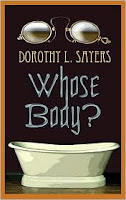
Whose Body? is Sayers' first Lord Peter Wimsey novel, and details his first attempt at solving a murder mystery.  When an unidentified man is found dead in someone else's bathtub, wearing nothing except a pair of expensive pince-nez, questions immediately arise about whether this could be Sir Reuben Levy -- a successful financier who disappeared the night before.  Based on the evidence, Lord Peter immediately disregards the police's theory, but he is intrigued enough to investigate both the murder and the disappearance.  Much of the novel focuses on unfolding the mystery, of course.  But there is a lot of attention paid to developing Wimsey's singular personality, which makes it far more enjoyable than other mysteries of the same era.

My library has only a few of Sayers' novels, so I next picked up a collection of short stories featuring Lord Peter Wimsey, The Complete Stories.  These were even more delightful and gave me a better appreciation for Sayers as a mystery writer.  Her plots are very imaginative and varied, with unusual points of conflict -- such as a dead uncle who bequeaths his digestive system to a favorite nephew  -- that are often more interesting than the murder mysteries.  Have you ever heard of mirror-image twins?  I hadn't before reading one these stories, and that's just one of many interesting twists.  Another plus; the style of dialogue and narrative voice clearly belong to that era, but her humor and intellect can be equally appreciated by today's audience.

I just finished The Nine Tailors, reputed to be her best Wimsey novel according to one reviewer.  Of the three books, I definitely saved the best for last.  In this mystery, Lord Peter is temporarily stranded in a remote village over New Year's Eve and is invited to stand in as a change-ringer for an ambitious peal the Rector has organized to ring in the New Year.  Having thus become linked to the Rector and the village, he is called back later in the spring to investigate an unidentified corpse that is unearthed in the churchyard.  The further he investigates, the more the corpse appears to be tied to a baffling theft in the village's history that led to the financial ruin of a noble house.  Sayers throws in some twists and surprises, including an "Aha!" ending that leaves the reader marveling at its genius simplicity. One of the things I really enjoyed about it is that instead of withholding crucial evidence from the reader, she presents it all so that you could theoretically figure it out yourself (even if you're like me and don't).  It was a smart and engaging story, and I'm wondering why it's taken me so long to discover these wonderful novels!

Wednesday, June 30, 2010

Co-review: The Weed that Strings the Hangman's Bag

Caren and I both loved Alan Bradley's book The Sweetness at the Bottom of the Pie and decided, since we're on a sequels kick for co-reviews these days, that we would do one for his next book.  The Weed that Strings the Hangman's Bag is another tale of mystery and murder with Flavia de Luce, chemist, poisons expert, detective, adventurer, clever liar, and not-quite-eleven-year-old.  This time she is investigating the mysterious murder of Rupert Porson, a puppeteer who arrived in Bishop's Lacey--the town in England where the story takes place--under unknown circumstances.  Porson is a famous man with his own television show on the BBC, and his puppets are beloved by children and adults the country over.  When his van breaks down in Bishop's Lacey near the parsonage, Flavia starts to help him out of curiosity.  As she noses out some mystery having to do with Porson's assistant, Nialla, Flavia can't resist snooping some more.

Flavia discovers that Porson is not a stranger to her small town and that somehow he is tied up with the mysterious death of Robin Ingleby, a young boy who died five years before.  Flavia also stumbles across a German POW who is working for the Inglebys and his role in events also surface.  In addition to all this, Flavia's Aunt Felicity comes to town to put their disastrous financial affairs in order and to chastise Flavia's father.  There's a lot going on, I know.  There's so many more new characters in this book, but we still have the delightful, gossipy Mrs. Mullett, the traumatized and complicated Dogger, and Flavia's fiendish sisters.  Each character is a delight.

With prompting from the vicar, Porson puts on a puppet show for the town.  It's like nothing anyone has ever seen, with obvious skilled craftsmanship.  When Porson drops dead at the finale instead of his giant puppet, Flavia instantly begins her detective work.  With her fascination with death and her precocious ability to ferret out facts, the police department is lucky to have her on the case. 

As always, we don't hold back in these co-reviews.  Since this book is a mystery and the ending a fairly good surprise, I don't recommend reading this if you don't want it ruined for you.  Seriously.  Don't read this.  Go read the first and second books, then come back.

Jenny:  Flavia is one of my new favorite characters.  She's so clever, so funny, so delightfully macabre that I can't get enough.  I wrote down page numbers of sections where I laughed out loud.  The part where she decides to ask Dogger what it means to have an affair?  Oh my gosh, I giggled so hard that my husband had to put down his book to ask me what was so funny.  Flavia is unapologetic about her methods and means.  For example, I loved this sentence so much I wrote it down: "I suppose there must have been times when I hated myself for practicing such deceits, but I could not think of any at the moment.  It was Fate, after all, who thrust me into these things, and Fate would jolly well have to stand the blame."  Oh man, she's a hoot. 

I think I actually liked this book better than the first one.  It was more shocking and funny and engaging.  I remember having to give the first book a second chance after almost returning it to the library, but this one I dove in and finished in a few days.  But that could also be because I knew what good stuff was waiting for me.

Caren: I loved the first book, and enjoyed this one just as much.  Maybe even more because I am a bigger Flavia de Luce fan now.  During the first book, I was so unsure of what to make of her -- she amazed me and creeped me out at the same time -- so I hesitated to fully embrace her and her quirkiness.  But now that I've had some history with her, I felt like I could relax and enjoy her bizarre talents without reserve.

While I was reading, I tried to decide if you had to have read The Sweetness at the Bottom of the Pie to appreciate this one.  I think it would definitely help, but isn't necessary.  Bradley did a good job of filling in any important information without giving away spoilers from the first book.

Oh, and I loved her conversation with Dogger about what it means to have an affair too!  And she is perfectly satisfied with his explanation that two people having an affair "became the greatest of friends."  Priceless!  Her maturity and intelligence juxtaposed with moments like that which showed her youth and vulnerability made her all the more likeable.

I'm curious how much of the chemistry in the story is accurate.  She's such a MacGyver when it comes to her homemade experiments.  It's awesome!  And I can't help but wonder how much research Bradley does for these novels and whether her exploits are at all realistic.

Jenny:  I bet he does his research, especially if you look at how long his acknowledgments are at the end of the book.  Plus, you gotta know people will write him and say, "Now on page 137, you mentioned these two compounds and they wouldn't really do that, blah blah blah."  The prospect of dealing with that would get me to do my research, anyway. 

I didn't feel any hint of how the mystery would unfold.  Bradley kept me in the dark.  I'm curious if you had any hints as to how it played out.

Flavia is MacGyver!  If MacGyver was a prepubescent girl obsessed with poison, anyway.  I was totally impressed with how she used her wits to save Grace at the end.  But those moments in the book make me think Bradley is trying to make her too clever and fast-thinking, beyond what is believable.  Then he reminds us that she's just a little girl through the torment her older sisters put her through.  Ah, Bradley, you tricky author you.

Caren: I didn't figure out who did it either.  I did suspect it was Rupert at the seaside when Sally mentioned the Punch and Judy show, but I didn't figure out the implications that he and Grace Ingleby had a thing going.  And I sort of had a hard time remembering Rupert was supposed to be such a ladies' man when all we saw of him was being an abusive jerk. I had kind of hoped that it was Cynthia or Mad Meg who killed Rupert because they would have made much better murderers than poor, pathetic Grace.

I really enjoyed learning more about Harriett, especially when Aunt Felicity tells Flavia that she is just like her mother.  I loath Flavia's sisters for how horrible they are to her and I hope that Bradley has some sort of redemption planned for her, because her home life really stinks.

One thing Bradley does really well is setting an eery tone.  The rotting gallows at the abandoned crossroads in the middle of the wood; the puppet with Robin's face; the shrine in the dovecote; they were all wonderfully creepy!

Jenny:  Yes, Bradley does masterfully create a scene.  I often felt like I was right beside Flavia as she raced around on Gladys, her bicycle.  When Flavia went to the old auto shop to retrieve some research, I got shivers when I remembered how she was trapped in there in the first book.  I love an author who can describe a scene so well that I find myself there with the characters.  Makes it so much more fun to read.

When Aunt Felicity tells Flavia that she is just like her mother, I cheered!  Those stinky sisters of hers, aptly nicknamed Feely and Daffy, are probably just jealous that their little sister ended up so much like their mother.  Like you said, I really hope Bradley has something nasty in store for them.  Of course, the rank chocolates at the end was pretty hilarious, though it would have been more funny if Feely had actually eaten some of them. 

Here's a random question: what's up with the butterfly on the cover of the book?  Do you remember anything about butterflies?

Caren: I think it referred to Nialla's butterfly compact that Mad Meg stole, but I was surprised it didn't have any real significance in the story.  I expected it to be a pivotal piece of the puzzle, but it wasn't.  Unless I missed something!

Speaking of the cover, I have to say that Alan Bradley does come up with the most unusual and unforgettable titles.  Kind of a pain to write out, but pretty cool!  And all the references to art, literature, history, and the sciences -- either he's one very well-educated writer or he's good at faking it!

Jenny:  I'm a fan whether or not he's faking it.  This is good stuff, my friend.

Wednesday, June 9, 2010

Maisie Dobbs

I just finished a novel for my book group featuring a young woman in England in the early 1900s who is notable for her intelligence and keen powers of observation.  She attends university, grows to adulthood during WWI, and is mentored by a much older gentleman with whom she solves cases and learns to be a private detective.  Sound familiar?  That's what I thought too, but it was not a Mary Russell mystery by Laurie R. King.  With so many similarities in the basic premise, however, it was hard not to draw comparisons.

Maisie Dobbs, by Jacqueline Winspear, begins with the title character striking out on her own as a private detective.  Her first case is a question of marital fidelity.  When a man comes to her with questions about his wife's activities, Maisie is eventually led to a private retreat/compound for WWI veterans whose facial disfigurements have made re-entry into society almost impossible.  As she investigates the compound with its unexplained deaths, she is also forced to face her own grief and loss that she experienced during her years serving as a nurse on the front lines.

Much of the story is told in flashback, giving us a look at how Maisie came from very humble beginnings but was blessed with the patronage of forward-thinking aristocrats, a university education, and tutelage from the sage-like mentor who teaches her about psychological detective work.  We see quite a few scenes from the war, but only the briefest hint of the graphic horrors that came with it.  Part mystery, part romance, part war drama, part period study, part social commentary; in my opinion Winspear tried to take on more issues than Maisie Dobbs was equipped to handle.  The character depth just wasn't there like it is with King's complex Mary Russell. I felt like Winspear shied away from exploring the nitty-gritty things that would have really turned Maisie into a well-rounded character.  Instead, she just gives the reader brief glimpses and expects them to fill in the depth.

Having said that, it was still an interesting story with a poignant conclusion that has lingered with me longer than I would have expected.  Is it enough to continue Maisie's story with the rest of the series?  (Because of course there's a whole series!)  I haven't decided.  I do hate to leave a series unfinished, and there's always a chance that Winspear's writing improves with time and experience.  Maybe my book group will offer an illuminating perspective.

Friday, April 16, 2010

Taking a trip with Mary Russell

I recently spent a couple of weeks out of town, and had a whole stack of library books to choose from to keep me company while traveling.  Some I'd picked up out of idle curiosity; some I checked out because I felt like I should read them, not because I really wanted to; and a few I was genuinely excited about.  Guess which ones actually got read while I was away.  What can I say?  I was on vacation!

A few months ago I read Laurie R. King's The Beekeeper's Apprentice, and was hooked on the delightful young and brilliant Mary Russell who is befriended and tutored by an aging Sherlock Holmes.  So I was happy to pick up the next in King's prolific series, A Monstrous Regiment of Women.  Once again, Mary Russell takes center stage with Holmes as an important, though secondary, character.  The politics of the post-WWI era come into play when Russell gets involved with a group that is part religion and part suffrage movement, led by a charismatic woman named Margery Childe.  As danger stalks Childe's inner circle of followers -- and Russell herself -- she puts herself at great personal risk to uncover the truth of the evil forces behind it all.

At the same time, Russell faces personal conflict in her relationship with Holmes.  As she has grown into adulthood her feelings of respect and admiration for him have blossomed into affection, but it's an affection that he shuns.  He is permanently entrenched in bachelorhood and wants nothing to do with affairs of the heart.  Russell herself is as much guided by intellect as emotion in her choice, since the two of them make a most logical match, but she feels deeply enough to be hurt by his rejection.  The tension it creates in their relationship becomes one of the most engaging parts of the plot, even though it's a minor subplot to the main action.


A Letter of Mary comes next in the series.  This time the mystery involves an old archeologist friend who is killed shortly after giving Russell a perplexing and tantalizing artifact -- a letter that purports to have been written by Mary Magdalene during the destruction of Jerusalem.  Russell's passionate interest in theology and strong feminist ideals are immediately piqued.  But it's her sharp powers of deduction and skill at intrigue and disguise -- accompanied by the indispensable Holmes, of course -- that helps to solve the mystery of her friend's murder.

As mysteries, both novels were interesting but not riveting.  If there was nothing else to them than the mystery, they would have fallen disappointingly flat.  (Which makes me wonder about King's other non-Mary Russell novels, since I think that mystery is the only genre she writes in.)  As period pieces, they were more intriguing due to King's convincing recreation of 1920's London with the politics and social issues of the time.  But the most engaging parts of the story surround the multi-layered character of Mary Russell.  Her strengths, her failings, and her human complexities are so well-portrayed that she feels like she could walk right off the page.  Throw in her fascinating relationship with Sherlock Holmes, and I think I could read about her forever.  And at the rate King is writing these novels, maybe I will!

Thursday, January 21, 2010

The Beekeeper's Apprentice

Laurie R. King started her Mary Russell mystery series over 15 years ago and has had quite some time to develop it. According to the inside of my paperback, she has eight novels so far. I just sat down this week with the first one, The Beekeeper's Apprentice, and wasn't disappointed!

The premise of The Beekeeper's Apprentice is that Sherlock Holmes is a real live person living out a quiet retirement in Sussex during WWI when teenager Mary Russell crosses his path. In many ways, orphaned Russell is a younger, female version of Holmes -- complete with acerbic wit, searing intellect, and a penchant for observation and deduction. Holmes is intrigued and sets about casually training her and honing her skills. Predictably, they work together on a few cases that get more dangerous and more personal as time goes on.

At first I wasn't a huge fan of Mary Russell. I enjoyed reading about Sherlock Holmes years ago when I was a teenager, but I wasn't excited to read about a younger, female version of him. So the first few chapters weren't very engaging to me. As she ages and matures, however, her humanness emerges and she becomes a much more sympathetic and interesting character. Holmes himself grew on me as well. It's been so long since I've read any of Conan Doyle's work that my memory of Holmes is a general feeling rather than specifically accurate. But eventually I was able to believe that he was THE Sherlock Holmes of Baker Street, even if King's version shows more empathy and gentleness than I remember from Conan Doyle's.

There is mystery and suspense, of course, but mostly it is about the relationship between Russell and Holmes. Holmes plays the role of friend, mentor, even father figure to Russell, but as she approaches her 20's there is definitely the underlying question of another form of attachment -- despite the difference of almost 40 years in their ages -- blatantly raised by outsiders if not the reader. Both Holmes and Russell are very devoted and pure in their friendship, but there is an intimacy there that makes me wonder what King has in mind as Russell grows into full adulthood.

I think I mostly enjoyed this book because I like Sherlock Holmes and I like strong female characters and King did a good job creating both. I'll definitely have to come back for more!

Saturday, October 31, 2009

Co-review: Murder on the Orient Express

In celebration of Halloween, we chose a classic mystery by Agatha Christie for October's co-review. I can't think of any authors who have been more prolific than Agatha Christie, the Queen of Crime who helped shape the modern mystery. Her classic who-done-its often include a brilliant yet unassuming private detective whose keen powers of observation and deduction culminate in a surprise conclusion where the murderer is revealed to the astonishment of all. Sound familiar? Yeah, it's pretty much your standard murder mystery template. But unlike Doyle's Sherlock Holmes, Christie's work doesn't center around any single character, though she does have a couple of favorites who get a lot of air time.

Murder on the Orient Express features Christie's famous Belgian detective, Hercule Poirot. When a passenger train gets stranded in a snowbank in Yugoslavia, one of the passengers is murdered in the middle of the night. Knowing the murderer must still be on board, the railway director entreats his friend Poirot (who happens to be traveling on the same train) to solve the crime. The majority of the novel consists of the various passengers offering alibis and evidence while Poirot sorts through the confusing mess to uncover the truth. It is a puzzle of logic and deduction for the reader as well since reserving the great unveiling for the end gives us a chance to develop our own theories along the way. And be forewarned that since this is a co-review, we can't promise not to give away any spoilers!

Caren: It's been many years since I've read an Agatha Christie novel, so it was fun to go back and revisit one of the classics. The most obvious difference from modern mysteries was the absence of action, violence, and nail-biting suspense. Instead, it was all about laying the information out for the reader to sort through and see if we could figure it out on our own. We weren't allowed much access into Poirot's mind so we had to rely on our own powers of deduction. But I have to admit that I didn't even bother trying to figure it out myself. I knew there would be an unexpected twist at the end, so I just decided to take the lazy route and wait for Poirot to spell it out for me. What about you, Jenny? Did any of the characters seem more suspicious to you than the others?

Jenny: No, in fact I kept thinking how strange it was that everyone was so devoid of suspicion. Of course, you realize why at the end and it starts to come together as more and more characters have a link to the Armstrong kidnapping/murder. Very different from modern mysteries. The other big difference I saw was the stereotypes that were used, like "women are hysterical" or "Italians like to stab with knives". Those kinds of statements in modern novels would be used to show how non-politically correct a character was. In Orient, they came across as completely normal. It was interesting to me to see how much our society has changed just from what we can read in a mystery novel.

The way the book was organized was very interesting. The crime section was first, then the testimony of each passenger, then the re-examination of evidence and testimony, then the grand unveiling. I would be interested to see if that's how all of Christie's novels are written. You can't beat Poirot for cleverness though. That guy has it together.

Caren: It's been a while, but I don't think Christie employs this same format in all of her novels. Some of them have multiple murders with suspense building the entire time, if I remember right. But they all include the grand unveiling at the end.

Good point on the stereotypes. Definitely written in a different time! There were some other things too that didn't fit with a contemporary audience. Some of the clues Poirot picked up on meant nothing to me -- like when he identified Miss Debenham as having spent some time in America because she referred to a telephone call as "long-distance." There were also times that Christie deliberately withheld information from us, and I thought that was a little unfair. For instance, the detail about the bolts on the even numbered rooms being in a different location than the odd numbered rooms. I don't mind if I'm not as smart as the guy solving the crime, but I do think it's only fair that I get the same information he does. Or at least a hint.

I had a hard time believing that these people were all capable of murder. It made for a good story, but it was hard to imagine some of them actually being able to stab another person. That's just so brutal, and they didn't seem twisted enough by revenge to be capable of it. But maybe I'm just looking at it through contemporary mystery eyes again.

What did you think of them all getting away with it in the end?

Jenny: Oh no, I agree with you on that point. I hardly think every single one of the characters capable of stabbing someone. And you're talking about people who were involved in the Armstrong household, not direct relatives or people I would think could hang onto that kind of fury and be part of such a nefarious plot. I think Christie probably thought it would make a good story and show off Poirot's skills and didn't think too hard about their motivation.

I have a hard time with endings like this. My innate sense of justice feels annoyed when people get away with murder (pun intended). Did Ratchett/Cassetti deserve to die? Yeah, probably, but it wasn't those people's jobs to carry out his sentence. Now they have to carry around what they did and know that they got away with it. I couldn't live like that.

All that said, this book isn't a moral thinker. It was written as a romp and that's what it is. See the famous Poirot solve a murder case while stranded on a train! See Poirot use his powers of deduction to discover the hidden identities of possible murderers! I think I prefer a protagonist that isn't quite so infallible. Now that I think about it, though, we are a product of our generation and the literature and entertainment of our time. I bet in the 30's (when I think this book was published) this was exactly what people wanted to read. Otherwise Christie wouldn't have been the best at what she did.

Caren: Yes, it's a fun romp, but I do think that Christie was also trying to nag our moral conscience. From what I remember, she has quite a few novels that deal with uncomfortable ethical dilemmas like this. But I agree with you, it's not so well-developed that I'll be losing any sleep over it. Still, it's nice to know that even something written that long enough and filled with cultural references of the time can still hold some appeal today. It might not get your palms sweating and your heart racing, but it's still a fun murder mystery without the side effect of nightmares afterward. Which, in my opinion, makes it great for young teens who are getting introduced to the mystery genre but are still too young for the intensity of contemporary writers.

Monday, October 26, 2009

Thursday Next sequels

I've been interested in reading Jasper Fforde's Thursday Next sequels since Jenny and I co-reviewed The Eyre Affair back in May. But I could never seem to get my hands on the next one. So when I was recently in the library and found all of them together, I had to snatch them up. Guess what I've been doing for the last month?

So far Fforde has written four additional books about Thursday Next. Some have more action and mystery than the others, but they are all creative and fun to read. Lost in a Good Book begins with Thursday enjoying marriage to Landen Parke-Laine (her reconciled love from The Eyre Affair), and the revelation that she is newly pregnant. When the Goliath Corporation eradicates Landen in order to blackmail Thursday into releasing their agent Jack Schitt from Poe's The Raven (where he was imprisoned during The Eyre Affair), Thursday begins to search for a way to get back into fiction again. She enters the BookWorld and joins Jurisfiction -- the organization that maintains order within fiction -- as an apprentice to the one and only Miss Havisham. In the meantime she faces another enemy, Acheron Hades' sister Aornis, saves the world from being turned into mysterious pink goo, and releases Jack Schitt only to be double-crossed by Goliath and still left husbandless.

In The Well of Lost Plots, Thursday decides to take refuge away from Goliath in the BookWorld, where she continues her Jurisfiction training and awaits the birth of her baby. There is less action in the first half of this book as she discovers all the oddities of the BookWorld. Fforde's imagination is limitless and it's sometimes hard to keep straight all the aspects of the world of fiction. But it rarely felt tedious and his wit kept things interesting even when the action was a little slow. Thursday faces some Aornis-imposed personal struggles with Landen's eradication, but is helped through them by Granny Next -- a delightful character who first appears in Lost in a Good Book. The second half gets more interesting as Thursday uncovers a greedy plot that would end up destroying libraries all over the world, and has to use her own wit and BookWorld connections to put an end to it. In the end she is appointed Bellman, the head of Jurisfiction.

Something Rotten begins over two years later. Thursday now has a 2-year-old son, Friday, and is getting tired of the BookWorld and returns home to Swindon. Goliath is trying to become a religion and promises to uneradicate Landen in exchange for her forgiveness, a process that doesn't quite go through without a hitch. In the meantime, a fictional character is trying to take over the world beginning by establishing himself as England's tyrant, Hamlet has undergone a hostile takeover and is now The Merry Wives of Elsinore and only an illegally cloned Shakespeare can possibly sort out the mess, a famous assassin is trying to kill Thursday, and Thursday has to save the world by leading the Swindon Mallets professional croquet team to an unlikely victory in the SuperHoop. Despite a few minor inconsistencies in the text, this was probably my favorite of the sequels. There are some great revelations and surprises, lots of loose ends tied up, and more action with the many subplots involved. The series could have easily ended very satisfyingly with Something Rotten.

But it didn't. First Among Sequels continues the story -- a little unnecessarily if you ask me. But it's still fun and is a little bit of a departure from the previous ones because it narrows the gap between the imaginary literary sci-fi world that Fforde has created (where something like SpecOps and the ChronoGuard could exist in the first place) and the real world that we live in. It takes place fourteen years later with Thursday in her early 50's, SpecOps disbanded, and interest in books falling in place of reality TV shows like "Whose Life Support Do We Switch Off?" Thursday is continuing to work in both literary detectives and Jurisfiction, albeit on the sly since she was supposed to have given both up years ago. As a mother, she faces the daunting task of trying to motivate lazy sixteen-year-old Friday who is resisting his destiny of joining the ChronoGuard. In the fictional world she meets with frustration and opposition from her own fictional counterparts in the badly written Thursday Next series. And in both worlds, she has to fight a movement to eliminate the classics and turn them into reality book shows where the readers get to vote off characters and decide where the plot will go. The ending is definitely left open for another book, so we'll have to wait and see where Fforde takes it next.

Overall, this was the most fun I've had reading a series in a long time. Fforde seems to know just how much he can use his jokes before they start to get stale, and moves on to something fresh and interesting before we get tired of them. I admire an author who can take his cleverness to new heights with each book, and Fforde succeeds in that. Also, it seems like usually sequels incorporate more sex, violence, and bad language than the original, but this wasn't the case with the Thursday Next sequels. In fact, if anything the language was less strong than the first and that is a great selling point to me. One thing the sequels lacked was a really strong villain. Acheron Hades was a great villain in the The Eyre Affair, but there's no one of his caliber in the other books. I think that makes them suffer a bit as mysteries (which is where they are catalogued), but they are still so fun to read that if you can get over that you'll still enjoy them.

Monday, August 17, 2009

The Sweetness at the Bottom of the Pie

I know all you RHE readers have been waiting with great anticipation to find out which book I finally committed to reading all those many moons ago. Thank goodness the survey forced me into a decision and The Sweetness at the Bottom of the Pie by Alan Bradley was the lucky book I got to read. I am so thankful that's what got the most votes because I was already four chapters in and it was easier to commit to it. Now that I've read it, you smart people who voted for it were very insightful. It was a fun read.

Flavia de Luce is the eleven-year-old daughter of a formerly wealthy British family who spends her time doing chemistry experiments and tormenting her vain and clueless older sisters. The book is set in 1950s England and Flavia has all the freedoms that most eleven-year-olds don't get any more. Like riding her bike to neighboring villages, the town library, and the police station. Seriously, what kid does that any more or has that kind of freedom? Or has parents that are that oblivious to what their kid is up to? But without those kinds of parameters, Flavia never would have solved the mystery of the murder committed on her family's land.

Flavia's father is a philatelist, or stamp collector, and the story revolves around two stamps that are unique and priceless. One is owned by the king of England, then stolen by the same man who stole its twin, who also happens to be the man murdered outside Flavia's window. Flavia's father is accused of the murder, due to his shady past in connection with the man and one other small piece of evidence: his confession. Flavia is pretty sure her father didn't commit the murder and is also fairly certain who he's trying to protect. She goes about her investigation to prove both of them innocent but unravels a whole ball of tangled yarn.

The characters definitely make the book from her vain sisters, their batty housekeeper, the flirtacious stablehand, and the petite and obnoxious piano teacher to the villain you think exists and the villain that is slowly revealed. Flavia is the best of them all as her persistent, intelligent, nosy, creative, and brave self. She's makes connections beyond her years, which is fine because this is fiction after all, but she never gets too far outside of reality to make the book a joke. She is what I kind of wished I was like as an eleven-year-old and I definitely would have wanted her as my co-conspirator. But she's not the type of child your parents would want you to spend time with, what with the obsession with poisons and all.

There's a sequel due to be out sometime and I'm putting it on the list. I love a good mystery, a good villain, and best of all, an amazing detective. The Sweetness at the Bottom of the Pie fits all those categories.

Friday, May 29, 2009

Co-Review: The Eyre Affair

Do you like a good detective story? How about one with a clever and emotionally tormented hero, a perfectly despicable villain, and a cast of bizarre characters that keep everything fun and interesting? The Eyre Affair by Jasper Fforde is set in an alternate universe where beloved literature and the arts are the things most holy. A place where you can get jailed for your bad interpretations of Shakespeare, where warring gangs of surrealists and impressionists start fights in the streets of London, where a branch of the police force is dedicated solely to investigating crimes against literature.

Thursday Next is a LiteraTec, a Literary Detective in the Special Operations police force. At the start of the book, she's investigating the disappearance of Charles Dickens' original manuscript of Martin Chuzzlewitz. As she gets further into her investigation, she becomes embroiled in the hunt for the villain most foul, Acheron Hades. He has committed numerous murders and is known for his cunning and seeming indestructibility. She also happens to know him from college, when he tried to seduce her but was impervious to his charms.

Acheron's plans are not just to steal manuscripts and other valuable artifacts, but to change them. His ultimate plot involves Charlotte Bronte's Jane Eyre and what he has planned would be considered a heinous crime indeed, especially in this alternate world where Jane Eyre is held so sacred. Toss in some family drama that includes Thursday's genius uncle and rogue father and a rekindled romance with her former fiance, and you've got some great reading here.

Jenny: This book was such a fun read. Female detectives tend to fall into the same stereotypes: tough, tortured, trying to make it in a man's world, an inky past that tends to catch up with them, and so on. Thursday is made even better than that stereotype by this amazing world she inhabits. There's so many literary references and jokes played on knowledge of the classics that I started to wonder if I was even catching them all, with my limited knowledge.

There were definitely some great fantastical elements to this book that I liked. Time travel, Acheron's uncanny abilities, and that random section with the vampire? It seemed out of place, but I like vampires so I forgave it. The way the SpecOps is set up cracked me up, that nobody knew what anybody else did and it was all so very hush hush. Made me excited to read more of the books to see what else Fforde has up his sleeves.

Caren: I had a lot of fun reading it too. Definitely imaginative! Any roughness in writing was made up for by the unexpected and delightfully fanciful world he created. Parts of it felt like a cross between Odd Thomas and Harry Potter. I loved the literary references too, and kept thinking I needed to brush up on my classics! My favorite parts were the references to the bookworms who lived off of prepositions and created apostrophes as waste products. I laughed out loud at how it affected the text!

I was disappointed in some of the bad language, and I'm not convinced that the story needed to continue into another novel, but when I am looking for another light and fun read I think I'll have to try out the next one.

Jenny: I think the key description for this book is, like you wrote, light and fun. No heavy thinking here. It's one you can pick up when you're not up for any serious contemplation.

I loved loved loved how Thursday helped change the ending of Jane Eyre from the "original" where Jane and Mr. Rochester never see each other again, to where she battles Acheron in Thornfield, Bertha dies, and all those other details that make the story so much more satisfying. Especially when she sneaks off to where Jane is living and yells her name outside her window. It tickled me pink. I've read Jane Eyre a dozen times or so and seeing it from this different angle was a hoot.

In all, it was a fun, easy read that made me laugh. It would be a good pick for some summer reading at the pool or on vacation.

Caren: Oh yes! It was so clever how Thursday's involvement becomes responsible for the Jane Eyre we know and love. And I loved that Rochester wasn't as cranky in "real" life (can you say that?) as he is in the novel. Another favorite -- the uncle's invention that allowed the person wearing this special hat to turn their brain off and watch soothing images of flying toasters. Silly, imaginative, and a whole lot of fun!

Monday, April 27, 2009

The Associate

I enjoy a John Grisham book as much as the next gal. When a new one comes out, I'm usually #375 on the holds list at the library, being too cheap to shell out $25 for it. His books are characterized (in case you don't live on Earth) by lawyers in trouble, using their wits to get themselves out of the grasps of greedy corporations/lawyers/individuals. I have my list of Grisham favorites and I get excited thinking that the newest one will be added to that list. Grisham's newest novel is The Associate and it won't be added to that list.

I promise to tell you why, but first I'll give you a synopsis of the book. Bright and hard-working Yale Law School student Kyle McAvoy is about to graduate and enter into the field of public service, using his gifts to help others. He is cornered by a mysterious character, Bennie Wright, who claims to have evidence that he was an accomplice to a rape that happened when he was 20 years old, living with frat brothers and binge drinking on a regular basis. The girl, Elaine Keenan, had cried rape back then, but was known to be premiscuous and unreliable, so the police couldn't put enough evidence together to prosecute. Kyle has moved on since then, so a video from that night with compelling evidence that there was, in fact, a rape is horrifying news. Kyle was passed out drunk on an armchair when it happened, but just being there is enough to get him a nasty trial and possible jail time.

Here's comes the extortion, people! Bennie wants Kyle to work for a huge law firm in New York City instead of the poor and downtrodden and act as a spy. Bennie's client wants documents and information about a huge lawsuit that has to do with contracts between massive corporations and the military. Kyle is pressured into this deed by fear of the damage that the rape video could cause. He never even told his parents about what had happened because the police never went forward with it. He goes to work for Scully and Pershing with Bennie's team hot on his trail, monitoring his every move, bugging his apartment and laptop and is forced into meeting with him on a weekly basis. His life is horrific.

Kyle is smart. He can lose the guys that trail him constantly. He knows about all the wiretapping and bugs and collects his own evidence of his blackmailers while he is under Bennie's power. The action is constant, the law firm brutally inhumane about how they treat their associates, the technology advanced, and the story keeps it all going at a fast clip. The problem was that I just don't care about Kyle. I wasn't emotionally invested in his success. He was no Darby Shaw (The Pelican Brief), Rudy Baylor (The Rainmaker), Mordecai Green (The Street Lawyer), Luke Chandler (A Painted House) or any of Grisham's other characters that I wanted to see succeed. I didn't wish Kyle ill, I just didn't care.

It didn't help that I didn't particularly like any of the other characters. Joey, Baxter and Alan were his former roommates and were unlikeable in every way. Baxter at least got sober and started making amends with people from his past, but that doesn't last for long. Bennie is a pretty good villain, but he gets very little attention other than Kyle obsessing over who he works for. Dale, Kyle's pseudo-girlfriend, is okay but gets almost no dialogue. Kyle's dad, John, gets a scene at the end that is one of the best parts of the book, but it was all of 5 or 6 pages. What this book lacks, that I know Grisham is capable of, is great characters. These characters are absolute dry toast and nobody likes eating dry toast. You only eat it if there's nothing else in the kitchen.

So sad. I feel frustrated when I read books like this from an author that can be really amazing, or just dumb. It's a gamble if my time spent reading his newest book will make it on the favorite list, or make me annoyed for having spent time on it. This is a draft of a letter I'm mentally composing for Mr. Grisham.

Dear John Grisham,
You know, I like your books. In fact, I was in Oxford, Mississippi one time and I actually went to the section of the library on the Ole Miss campus that is named after you. It was closed so I couldn't go in, but I pushed my face up to the glass and looked around as best I could. Most of what I know about the law comes from reading your books and I don't even care that it's fiction and therefore not reliable. I consider it gospel truth!

Now that I've buttered you up a bit, couldn't you put a warning label on the outside of each book, stating whether or not it is up to the caliber of A Time to Kill or The Runaway Jury or The Innocent Man? A big sticker, like the award stickers publishers love to smack on the covers of books, except it says, "Big Waste of Time But I Need to Make My Yacht Payments". I think people would appreciate the honesty. I know I enjoy a good fluff read every once in a while and I'd like to know if your latest book fluffs like cotton before I dedicate a Friday night to read it instead of playing on the Wii or clipping my toenails. You know, so I don't expect more than I'll actually be getting.

A big fan but probably not the biggest,
Jenny

P.S. Would you autograph this copy of The Broker and send it back to me? It's one of my favorites. Thanks so much!