It's fitting that this review comes so soon after Jenny recently reviewed Brandon Sanderson's newest book, since Dan Wells credits Sanderson with pushing him to write I Am Not a Serial Killer in the first place. Having Sanderson's support wasn't enough to make it very easy to get a hold of, though. Initially it was only published in the UK, then was released in the US last spring. But I still had to wait for an InterLibrary Loan (from out-of-state, no less!) to finally get my hands on it.
I Am Not a Serial Killer is a first-person narrative by an intriguing, yet disturbing, 15-year-old boy. John Wayne Cleaver is a morbid teenager who has been raised in a mortuary and has a keen fascination with death. He is obsessed with serial killers and makes a hobby out of studying them. The more he learns, the more convinced he is that he is destined to become a serial killer himself. But he doesn't want that, so he desperately follows a set of self-imposed rules to try to counteract his sociopathic tendencies.
Things change for John when a series of gruesome murders begin haunting the small town. John's unique perspective allows him to discover the murderer long before the police even get close, and he becomes convinced that he is the only one who can stop the killer. But to do so, he feels he must surrender to the monster within, and risk losing himself (or fulfilling his destiny, he's not sure which) forever.
As usual, we like to discuss these co-reviews openly, so consider yourself forewarned!
Caren: After a run of somewhat blah books lately, I Am Not a Serial Killer really made me sit up and take notice. I don't like guts and gore, so I felt pretty squeamish at the beginning when he was describing the process of embalming and the details of the first violent murder. Fortunately, he didn't go into a lot of graphic detail with every murder, or else I might not have been able to get much farther than the first few chapters! But I have to admit that I have a new appreciation for morticians now. I'm so grateful that there are people who make death so sanitary for the rest of us!
Jenny: I made the mistake of sitting down to eat my lunch while I read this book the first time. I made a note to myself never to do that again. It did make me grateful that there are people, non-psychotic people, out there in the world who are willing and able to do the work of preparing the dead for burial. 'Cause it's gross.
I thought it was fascinating that our protagonist and potential hero is a mentally-disturbed teenage boy with his own monster waiting to strike and kill. Very cool and original. Freaky too, but it made the angle of the story different than what I was expecting. Two things that took me by surprise was that we found out who the killer was fairly early in the story and that the killer wasn't human. I thought for sure this would be a murder mystery that put John into suspicion as the killer and then he used his knowledge of serial killers to find the real killer. Nope, nothing like that. When I realized that the story was more about John using his inner demon to destroy the actual demon, it was all symbolic and stuff.
Caren: I was surprised by the supernatural element too. John talks about himself and his disturbing tendencies in such a gritty matter-of-fact way that I expected the villain to be someone straight out of the news, not out of a comic book. And it sure surprised me when the killer turned out to be his harmless neighbor! (It's been a while since I've been genuinely surprised in a novel, so that was kind of fun.) In some ways it was probably better to have the killer be this weird demon masquerading as a nice old man. It was easier to read it late at night with the distance of "this could never happen in real life."
The demon was scary, but the creepiest and most disturbing thing to me was watching John struggle with his own unnatural inhumanity. It makes me wonder how accurate Wells' portrayal is from a psychological standpoint. I liked that John's therapist didn't think he was beyond hope, and I was glad that he shows himself capable of genuine feeling at the end when he and his mother defeat the demon. That gives me hope that he's not a true sociopath destined to become a serial killer like he fears. Even the fact that he doesn't want to become one should count for something, right?
Jenny: I have a really hard time with books or movies that are about horrific things that can actually happen in real life. Sci-fi doesn't scare me, just gives me the fun heebie jeebies. If the killer had been a real person, it would have been way harder to read and I definitely would have avoided reading it at night. For that I'm glad it was just a super creepy killer monster with a soft side for his wife.
What was really scary to me was when John let his inner monster out. When he bashed Mrs. Crowley's head with the alarm clock and barely stopped himself from killing her, I was in agony. I begged Wells not to let John become the monster that he was threatening to become. Like you said, I also like that his therapist was a good person who truly thought John was a good person with a strong moral code. He needed Neblin at that critical point and Neblin didn't fail him. It cost him his life, but it kept John under control.
At that point in the book, my heart was pounding in my chest and I could barely breathe. As soon as John saw on his GPS that the demon was heading back to the house, I thought I was going to jump out of my skin. It's been a while since a book had me in such suspense.
Caren: Oh man, me too! It's a good thing it didn't get any more suspenseful because I could barely stand it as it was. Which made it perfect for Halloween! And yet, for as creepy and violent as it was, it was surprisingly clean. I can't remember any bad language or anything sexual, which I would have expected for an edgy novel about a would-be serial killer.
I thought Wells did a really good job with the suspense and developing John's character. In the acknowledgments, he insists that it's not autobiographical, but I wasn't convinced. That's how believable John's character was! (That, and I can't help but wonder about how well-balanced an author can be who writes about such psychosis so convincingly.) But I admired Wells' restraint. He showed us just enough of John's dysfunctional relationships with family and friends and his obsession with serial killers to give us a clear picture of his psyche without overdoing it. It would have been really easy to go over-the-top with a character like John, but Wells didn't, and his reserve made for a stronger novel.
I am both intrigued and nervous that Wells intends this to be the first of a trilogy (I think the second was just recently published). Intrigued because I am a little curious about what happens to John now. He's made a breakthrough with his mother. He has let loose his own monster with it's major issues. And there were enough references to his father that make me wonder if there is more to come with that story. But I am nervous that for the story to continue, it will only be because John has greater demons -- both within and without -- that he has to face. I'm not sure I can handle that! And I definitely don't like what more novels might mean for the sweet and innocent Brooke that he's stalking at the end. It makes me shudder just thinking about it!
At least he ends this first novel well enough that I don't feel like I have to read the next one to finish the story. I always appreciate that in an author!
Jenny: Yeah, I just read online that it was going to be a trilogy. It didn't have the feel of a trilogy at the end of the book, so I was surprised. I'm kinda excited to see where Wells takes John and his tortured self. There was some seriously scary and upsetting parts in this book, but nothing that wouldn't stop me from reading the next two books. I have enough faith in Wells' plans for John that I think it could turn out okay in the end.
I just remembered that we read Odd Thomas a few years ago for our October co-review and how scary that was. Comparing Odd and John to each other, they are polar opposites. Odd is peace-loving and non-violent except when he's forced to while having a strange ability thrust upon him, while John is tormented by desires to do great violence and constantly keeps it in check. Yet, I think I like John just as much as I liked Odd. Not because John is inherently likable, but because he works so hard to be good. You've read more Odd Thomas than me, what do you think?
Caren: You know, it's funny that you mention Odd Thomas, because I thought of it too. Partly because that was probably the last time I read something this suspenseful, and partly because of the supernatural element. You're right that whereas Odd is so good and innocent, John is just plain scary. But at the same time I can't help feeling compassion for him and wanting everything to work out. I liked him, even though he freaked me out.
One thing I liked about the story is that as disturbing as it was, there was no such thing as violence without consequences. So often in the action/thriller genres the good guys commit necessary acts of violence without it affecting their characters. But the violence John committed changed him, just as it would in real life. I liked that Wells forced us to face that when a good guy does bad things he can't walk away unscathed.
Okay, I looked up the next one and it looks to be even darker and more intense than the first. It's called Mr. Monster and picks up right where I Am Not a Serial Killer ends. The reviews look compelling; people seem to like it even more than the first. Tell you what, you read it and then let me know what you think. Maybe I can muster up enough courage if I know it's worth it.
Jenny: Deal. I will totally take care of that for you. I'm excited to see where Wells will take the story.
Showing posts with label Fantasy. Show all posts
Friday, October 29, 2010
Tuesday, October 19, 2010
The Way of Kings
One of these days I need to stop reading so much and actually write something down. My pile of finished books keeps growing larger and the blog grows dustier by the minute. The bigger the pile gets, the more intimidated I get by how far behind I'm getting, which makes me hesitate even more. It's a vicious cycle. I should just take notes from Brandon Sanderson who seems to write about a hundred pages a day. That guy is producing huge amounts of writing per year and has tons more books lined up for publication. His latest book is The Way of Kings, a whopper at 1,000 pages and the first in what it planned to be a massive epic series. I'm glad I'm getting in at the beginning of this because if I were to look at ten or so books with 1,000 pages on average twenty years from now, I'd throw my hands up and say forget it. I don't seek out epic, lengthy fantasy series in general, but for Sanderson, I'll dive in quite happily.
Brandon Sanderson has a gift for world building in his writing. Well, he also has a gift for witty banter, clever plot developments, believable characters, engaging stories, and fascinating magic systems, but let's focus on the world building for now. I've had my fill of elves and goblins and apparently so has he because I've yet to read a book of his that has any of the traditional fantastic characters. In The Way of Kings, it's a world populated by different races of people, some more colorful than others. By colorful, I mean some have blue skin, some have super long white eyebrows and some have marbled black and red skin. In the country of Alethkar, the nobility is determined by eye color, the lighter the better. Dark-eyed people make up the working class. The nobility have swords and armor that are remnants of an ancient warrior group called The Radiants, and all of their major wars and even minor skirmishes are in pursuit of these swords and plates. Men who possess Shardplates and swords are called Shardbearers and are very hard to defeat, though it is possible and the swords and plate have passed hands many times over the centuries. The ancient Radiants used the weapons to defeat the evil Voidbringers and protect mankind, but they are no longer used for such noble purposes.
The world is afflicted with regular hurricanes, called great storms, that occur every few weeks. The seasons are very short and unpredictable. Because of this constant barrage, the flora and fauna have both had to adapt. The animal life is made up of animals with hard shells, like giant crawfish and clams. Being able to draw into their shells keeps them safe during the worst of the storms. Even the trees and plants are able to draw within a shell to stay safe, which is kinda bizarre. The ground is scoured and barren due to the fact that no soil can stay put with winds like that constantly blowing. There are other parts of the world that are more like the world we live in, but the residents of Alethkar think it's mythical and have a hard time believing anything could be different from what they know.
Our cast of characters includes Kaladin, a dark-eyed slave who was once an apprentice surgeon and then soldier. He is now a bridge carrier for a lord's army, a ranking that means certain death and reserved for the most disposable men. Kaladin has a sad past and the unnerving ability to stay alive even in the most dangerous situations. His past is slowly revealed and we get to watch him change his bridge crew into more than just disposable workers. His dealings with the nobility and his superiors in the army were so frustrating though, since the way their aristocracy is set up is so stupid. Sanderson is good at making me frustrated on behalf of his characters.
Another character I loved was Shallan, a minor noble from a small nation whose family has fallen on hard times. Her only hope is to become a ward of the princess Jasnah Kholin, sister to the king. She's a famous scholar and heretic and becoming her ward would put her in a position to save her family from destitution. Shallan is an amazing artist with a photographic memory and many of the illustrations in the book are from Shallan's notebooks. Shallan is fascinating because you think you know what is motivating her and then Sanderson surprises you. What happens with Shallan towards the end of the book knocked me for a loop. If I had written this book, I would have been giggling with glee at my deviousness, so I like to imagine Sanderson chuckling as he typed on his laptop, delighted with his own cleverness. Chuckle away, Brandon.
Instead of describing each character, which is what I'm tempted to do because I like them all so much, I'll just tell you that Sanderson creates a colorful cast and keeps the stories moving for each of them. When their paths collide, it's awesome. My only complaints about this book is that Sanderson takes his sweet time setting everything up. It wasn't until halfway through the book that it started to move faster. I know he's planning on making this a ten book series and that the details he's laboring over in the first hundred pages or so are important to the series as a whole and not just this book, but it doesn't make it any less slow to slog through. My other complaint is that there's not a whole lot that is concluded in this book. Some, but not much. Again, ten book series, yadda yadda. It makes me tired to think I'll have to somehow retain a bunch of this information and detail until the next book comes out. I don't know if I have room in my brain.
Oh well. Knowing Sanderson, the next book will be just as awesome and I'll read it happily and if I can't remember details, it won't matter all that much anyway because it'll be so fun to read.
Tuesday, September 28, 2010
Forest Born
Forest Born is Shannon Hale's most recent addition to what is now being called her Books of Bayern series. What started out as a complex and imaginative retelling of the lesser known fairy tale, The Goose Girl, has spread to four novels featuring selected characters from the original story and their supernatural gifts. Forest Born is different from the other stories in that it features a young girl who wasn't part of the original tale. Rin is the younger sister of Razo (who received his own story in River Secrets, the third Bayern book), and as with the other forest born characters we've met so far, she finds herself leaving the forest and moving to the city where she experiences some defining coming-of-age moments.The reader quickly discovers that Rin has a special gift -- that of tree-speaking -- which is expected in these tales of people-speaking, wind-speaking, fire-speaking, and so on. It takes Rin a little while to realize this, and causes her some grief because for some reason the trees have seemed to turn against her. Anytime she tries to communicate with them she is filled with such loathing and rejection that she decides to flee the forest and see what the future will hold for her in Bayern's capital.
There she becomes a lady-in-waiting to the queen, Ani/Isi from The Goose Girl. Rin helps care for Isi's young son, and develops a great amount of respect for Isi and her friends, Enna and Dasha. When the three "Fire Sisters" leave to investigate some mysterious burnings near the border, Rin secretly follows. As she grows to know these women better, and as they band together to face a secret enemy, she also begins to face her own self-doubt and desire to know who she really is. That means solving the mystery of her personal conflict with the trees, and coming to terms with another gift she possesses -- a dangerous one that can destroy her and all she loves.
It was a good story, and well-written as all of Hale's work is, but it wasn't my favorite of the four by any means. It was hard to really connect with Rin, since she spends most of her time observing rather than participating in many of the interactions with the Fire Sisters. But there's a reason for that, and Hale does do justice to the psychological and interpersonal issues she explores. It was fun to see so many characters from the earlier books and continue to follow their stories. There is action and suspense and drama, though it didn't feel quite as fresh and intense as in the first two books, The Goose Girl and Enna Burning (my two personal favorites). So worth reading if you've enjoyed the others, though not necessarily worth raving about. I do have to mention that reading it right after finishing Avalon High gave me an intellectual sigh of relief. I'll pick up a Hale over a Cabot any day!
Okay, and one more thing that bugs. I loved the stylized artwork they used for the cover art of the first three books. But when they printed them in paperback, they switched to some cheesy model photos (my mom aptly described them as "seductive American Girl"). Bad enough to do that to the paperbacks, but whatever. Until they also used that style for the hardback printing of Forest Born, and now it sticks out like a sore thumb against the other three books in my collection. I much prefer the classy style of the first three and wish they had kept it up for continuity. Lame.
Tuesday, August 31, 2010
Chalice and Avalon High
One advantage to having a nursing infant is the opportunity to sneak in a chapter here and there throughout the day (and night). One disadvantage is finding the time to write about what I've read when I can think in coherent thoughts and type with both hands!
A while back, I read several quick YA fantasies, but haven't had the time to write about them until now. The first was Chalice, by Robin McKinley. McKinley's Newberry award-winning Hero and the Crown was my first introduction to fantasy when I was young, and I've enjoyed the handful of other novels I've read by her. I was actually looking for one that had been recommended to me, Spindle's End, which is a retelling of Sleeping Beauty (I think). But it wasn't in, so I had to settle for Chalice. Chalice is the story of Marisol, a common beekeeper in the Willowlands who is chosen to be Chalice (a ceremonial position that is part political and part religious). She assumes the position in the midst of great turmoil after a disastrous accident claims the life of the former Chalice, as well as many of the local leaders, including the Master himself. The Master's younger brother had been sent away seven years before to become a priest of Fire, but he is called back to fill the role of Master upon his brother's death. Not quite human any longer, however, he has difficulty fulfilling his responsibilities and gaining the people's trust. Marisol believes in him, however, and does what she can to save her people, her Master, and the very land itself from outside forces that would try to destroy it.
It was an interesting plot, but fell far short of it's potential. Part of the problem is that Marisol is so isolated in her role as Chalice that we spend pretty much the whole novel in her head. There is very little dialogue and even less action. One scene that could have been a moment of high drama and tension feels shallow because Marisol misses it and has to be told about it later. I know from her other books that McKinley can do action, so I'm not sure why she shies away from it in this novel. There is a hint of romance, but it doesn't develop into anything worth getting worked up about. The political intrigue was interesting, but I felt so trapped in Marisol's thoughts that it too fell flat. Next time, I'll stick with Spindle's End.
After seeing her novels on my teenage sisters' bedside tables for years, I finally read my very first Meg Cabot story. Cabot is probably most famous for her Princess Diaries series. My introduction to her work was through Avalon High, an Arthurian story set in a contemporary setting. Ellie has moved to Maryland because her parents (who are professors with specialties in Medieval times) are on sabbatical for a year. Ellie isn't thrilled about the idea of starting a new school, but things look up immensely when she meets Will; the gorgeous quarterback who also happens to be smart, honest, upstanding, and idolized by everyone in the school. What's surprising is that he takes notice of her, and even begins to prefer her to his beautiful cheerleader girlfriend, Jennifer. Soon Ellie discovers that Jennifer is cheating on Will with his best friend, Lance. Over time, more and more parallels can be seen between this little high school drama and that of Arthur's Camelot, and Ellie begins to wonder how she fits in and what she can do to stop the evil events that are destined to follow.
It was a cute little story that didn't take itself too seriously, with plenty of humor to make it light and easy to read. But the teenage-speak got pretty old after a while, and the characters felt like they had just walked off a teen movie set. The plot was predictable and the whole thing was really lacking in substance. I did think the historical aspect looking at Arthurian legend was interesting, but if all of Cabot's work is like this, I'll leave it to the teenagers.
Monday, July 12, 2010
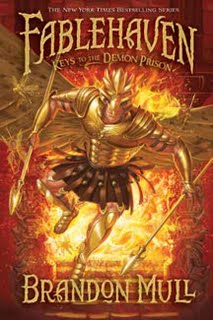
Fablehaven: Keys to the Demon Prison
In March, my family began the epic project of reading out loud the entire Fablehaven series by Brandon Mull. Sounds like we're some kind of awesome people, doesn't it? It wasn't intentional at first. The final book of the series came out in March and my husband bought it the day it came out. He brought it home and put it on the table to tempt me. I knew we'd have to do some negotiating about who would get to read it first, but he was going out of town soon, so I figured I could read it first and then he could take it with him when he left town. Then he suggested we read it out loud to each other so we could enjoy it simultaneously. I pointed out that he was going out of town and it didn't sound like any fun to be reading it over the phone or webcam. He teased that he was just going to take it out of town with him anyway and leave me hanging. Har har. Then he suggested we read the entire series and then culminate with the fifth book. I grumbled. He upped the requirements by suggesting that we read the entire series as a family. I grumbled some more, but mostly for show because it sounded like fun. My oldest had read the first book, but no more. We'd get to enjoy the series again through our kids, which was a worthy project. I agreed and we began.
Nearly every evening for more than three months we read. Mostly it was one chapter at a time but we'd fit in two chapters when we could. Nobody wanted to miss out so we had our bed full of kiddos while we read. Good thing we bought a king-sized bed last year or there's no way all six of us would have fit. My three-year-old would lose patience on occasion, but that wasn't until the later books when the plot got more complex. We would placate her by reading a stack of picture books before we began. One of my favorite parts was how my kids would talk about nothing else when an exciting part happened. Or maybe it's when they would laugh over and over again when Seth was up to his antics. Or maybe it's when they were absolutely entranced while we read to the point of hypnotism. Or maybe it's when my oldest would exclaim every single night, "I can't stand cliffhangers! Please read another chapter!"
By the time we got to the final book, it felt a bit like when the seventh Harry Potter came out. The anticipation and build up for this culminating event was palpable. We were all dying to find out what was going to happen. We went on a trip out of the state at the same time we started it and I read sometimes four chapters a day while we drove or had down time. When we reached the last ten chapters, I would read sometimes for an hour. My husband had strep throat so I was doing all the reading. It was worth it.
I've blogged about this series so many times, I'm not going to bother adding a link here. Just put in the search box the word "Fablehaven" and see how many posts show up. There's a bunch. I have enjoyed this series each step along the way. My only complaint is that the language some of the adults use seems forced. Nobody really talks like that unless they're trying to sound intellectual. On the flip side, Mull has got Seth and Kendra down pat. He knows exactly how to write a kid's voice. Plus, Seth and Kendra have a completely believable sibling relationship. Since they are the focus of the book, it is a treat that he wrote them so perfectly. And enjoyably.
I don't know exactly what to write about the final book, Keys to the Demon Prison. If you haven't read any of the previous books, nothing I write would make any sense. I think you'd have better luck reading previous posts to see if it's the kind of book you'd be interested in for yourself or a kid you know. I will say that it delivered on every count and that it ended exactly how I hoped it would, but better because Brandon Mull has a better imagination than me. I will also say that if you like Harry Potter, you'll like Fablehaven. Harry Potter comparisons get old and are kind of ridiculous, but I'm comparing them in the sense that both series appeal to any age of reader. Unless you hate fantasy books, which just makes me sad.
Brandon Mull is coming out with a new series next year called The Beyonders. I think it's safe to say that we'll be reading it at our house. We'll have to read Mull's The Candy Shop War in the mean time to sate our need for his amazing writing.
Tuesday, July 6, 2010
The Short Second Life of Bree Tanner
Stephenie Meyer's newest work, The Short Second Life of Bree Tanner: An Eclipse Novella, is a great example of how to milk one success for all it's worth. Can you imagine any other author being taken seriously with the following pitch?
Meyer: I have this random character who is so obscure and receives so little airtime that if you've only read the original novel once you won't even remember her. But I'd really like to tell her story.
Publisher: Oh, so you'd like to finish her story for all the fanatic readers who obsess over every little character and wonder what happened next?
Meyer: Well, no. Because I killed her off at the end of the few pages that she appears in. So there is no "next." I want to tell her story that led up to her death.
Publisher: You mean, give her personal history so that we understand better how she came to make the choices that led to her tragic end?
Meyer: Sort of. Actually, I don't care about her personal history that much. Mostly I'm just going to focus on the couple of days leading up to the death scene. You know, the scene that readers are already familiar with so they know it won't end well for this character. And I'll be sure and introduce a lot of new characters too so that the reader is even less invested in what's going on.
Publisher: I see. And you really think that people are going to buy this novel?
Meyer: Well, it's not a novel exactly. Really, it's just a teeny little indulgence. I could easily just publish it online as a treat to my die-hard fans, but why not try to make a few bucks by piggy-backing onto the success of my previous series? Go with the black, red, and white color scheme and you've pretty much covered my kids' college tuition right there!
Any other author wouldn't be taken seriously, let alone granted a nice hardbound publication of their little pet project. But any other author wouldn't be Stephenie Meyer, with printing houses falling all over themselves to publish her next work, even if it's just last week's grocery list. That's not to say that I didn't enjoy reading The Short Second Life of Bree Tanner. It was short and fast-paced and I can think of worse ways to spend an afternoon. But I'm afraid Meyer's fame has made her lazy and as long as it's so easy to coast on her previous success, she doesn't have any reason to work at developing her potential as a writer. (Potential which, while it exists, is still very rough.)
But back to Bree. We first meet Bree Tanner at the end of Eclipse after the fight between the Cullens and Victoria's army. Bree is a newborn vampire who apparently doesn't want to fight and surrenders to Carlisle. But when the Volturi come on the scene, they don't honor the surrender and she is quickly disposed of. The Short Second Life of Bree Tanner shows us her life in the few days preceding the battle. We see what it's like to be a newborn vampire and her chaotic and fearful life in the growing army, including more gore than we get in the other books. And then we see the battle play out from her perspective, offering additional insights into the scene we first saw in Eclipse. But, you know, it ends the same way.
Because of the brevity and knowing the ending in advance, it was hard to feel very invested in Bree or any of the other characters. It was interesting to see her as a newborn because I felt like Meyer really shied away from that when Bella became a vampire. But it was interesting from a "gee whiz" standpoint, not because it really added anything. And it was kind of hard to feel attached to a character who kills innocent victims and drinks their blood. Okay, but here's a funny thing. In all the original novels Edward is referred to as having this unusual bronze-colored hair. That's one of his defining features, right? So when Bree starts talking about this redhead at the end, at first I didn't know who she was talking about. And when I realized it was Edward, I wanted to laugh. Doesn't Stephenie Meyer know that redheaded males are considered the least attractive people in just about every culture? Shouldn't she know better than to downgrade her leading man's status like that? So that was confusing and distracting and just a little bit weird. I'm really not sure what that was all about.
But there you go. Another vampire tale, and quite frankly, I'm hoping that she'll try her hand at something else for a while. No harm in that since we know the publishers will be lining up to print whatever she wants!
Wednesday, May 26, 2010
How to Spin Gold
I have a problem. If something bothers me when I'm reading a book, I tend to let that prejudice my opinion and pretty soon I can't see anything good about it. I obsess over that one fault and refuse to find redeeming qualities. I know, not good. I'm working on it. Such was the case for How To Spin Gold by Elizabeth Cunningham. It is a retelling of Rumpelstiltskin, though it was written way before fairy tale retelling became popular. It's also written for an adult audience, so it's not really in the same genre of Ella Enchanted or The Goose Girl, which are written for young readers. It's more like Cunningham used that tale as the framework for her story.
Our main character is the Girl with the Silver Eye, unnamed because she was never given one until later in life. Born crippled and with eyes of different colors, the girl is shunned by her village and her family. Set during 12th century, women have few opportunities in life besides having marriage and babies. After a random meeting with the Prince, the girl decides to make her own way in the world. She meets up with the Wise Woman of the Western Wood. Or Witch, as most call her outside of her hearing. The Mother, as she prefers to be called, takes the girl under her wing and teaches her herblore, midwifery, and everything about her small domain in the woods. The girl is a quick learner and adds her own mastery of needlework to the pot.
The girl is tormented by her obsession with the prince and with the girl who eventually marries him. She becomes the Mother's heir and eventually learns her true name, but she's so dissatisfied with her life that she lets her anger and jealousy become an obstacle. Then, when the moment comes where she saves the new Princess's life she demands a harsh price: the first daughter born to the Princess. Only when the baby is born, she is unable to take her away when she sees how much the Prince loves his daughter. She's not as harsh as she wishes she was.
There are so many aspects of this book that are lovely. The evolution of the girl, her reconciliation with who she really is versus what she wishes she were, the contrast of following light or being consumed by darkness, and the themes of forgiveness and redemption. But I hated the language. I didn't like how Cunningham was trying to write as if she were a writer of that time period. I also thought her feminist empowerment idea had made for really one-dimensional male characters. It bugged me. It wasn't until I went to my book group meeting and listened to everyone's perspective on the book that I realized I had almost missed out on so much because of a couple of hang-ups. What if this hadn't been a book group selection and instead I had read it on my own and then panned it here on Red Hot Eyebrows? Then you all would have missed out too, if you took my word for it.
Thanks to the lovely women of my book group who showed me the light. Next time I think I don't like a book, I'll just ask some of them to read it too and tell me what I can't see. I wouldn't list this on my top books for 2010, but it certainly had more value that I originally gave it.
Tuesday, April 20, 2010
The Lightning Thief
I have heard from a lot of people who enjoyed Rick Riordan's book The Lightning Thief, so I was interested when our book group picked it for this month's read. Getting through the wait list was quite the ordeal, but that's usually a good sign, right? I knew very little about the story going into it, except that it was "like Harry Potter," and involved kids who were the half-mortal offspring of Greek mythical gods. I'm always dubious when something is marketed as being "like" another huge success, but after reading it I can see both why it would be called that, and also how that's not really a fair description.
Percy (short for Perseus) Jackson is a troubled teen being raised by an angelic mother and repulsive stepfather in New York City. His academic and behavioral problems mean he has bounced around from school to school, and when the story opens he is finishing out his sixth grade at a boarding school for juvenile delinquents. Bizarre experiences have happened to him over the years, but nothing quite as strange as during the opening chapter when his math teacher turns into a freakish creature and tries to destroy him while on a school field trip.
After school lets out, Percy continues to be pursued by dark forces until his mom sends him to a special summer camp that his absent and mysterious father had always wanted him to attend. Eventually he discovers that his father is none other than Poseidon, who together with Zeus and Hades constitute the Big Three. But the Big Three had made a pact following WWII not to have anymore mortal affairs (because it was their offspring who were responsible for the war), so Percy isn't even supposed to exist and is already in mortal danger just for being born. Then add to that the fact that Zeus's master thunderbolt was stolen right around the same time Percy's existence comes out and he is immediately suspected. The only way for him to clear his name and prevent a catastrophic world war is to find the lightning bolt and return it to Zeus. Thus starts a quest that takes him across the country, into the bowels of the Underworld, and to the heights of Mt. Olympus. Like any true heroic quest, he fights mythical monsters and other sinister traps, learning lessons about courage, friendship, and his own worth along the way.
The parallels to Harry Potter are pretty obvious. Adolescent boy (not quite an orphan in Percy's case, but close) who struggles to fit in discovers that he possesses special powers and belongs in a secret world that co-exists with the known world but the majority of humanity is blithely unaware of it. Some of the things that make the story so delightful were similar attractions in Harry Potter. The juxtaposition of the mythical and the contemporary were refreshingly creative, and the whole thing was infused with a light-hearted humor that made it a fun romp. Riordan's writing isn't as well-crafted as Rowling's, the plot twists were more predictable, and there wasn't the greater underlying depth that made Harry Potter so much more than just a fun story. But I've also only just read the first in the series so I can't say how those things may change over time. Beyond that, though, I hesitate to draw more parallels with Harry Potter because I think Riordan's work can and should be allowed to stand on its own. He definitely had command over the story and action and there was no sense that he was just trying to milk another Harry Potter success.
Some of the things I liked most about The Lightning Thief were, as I said before, how he meshes the mythical world with the "real" world in ways that are cleverly convincing. (For instance, demi-god children are prone to dyslexia and ADHD because their brains are hard-wired to read ancient Greek, not modern English, and their natural battle reflexes make it difficult to sit still in a formal classroom.) Another plus -- I have always enjoyed studying mythology, and it was fun to dust off some of the cobwebs in my memory to appreciate how Riordan was bringing it to life. I also enjoyed the first person narrative. It was very direct and funny, but without resorting to immature humor or adolescent stereotypes to convince us it was a 12-year-old talking. Just as an example of the strong narrative voice, some of the chapter titles are, "I Become Supreme Lord of the Bathroom," "A God Buys Us Cheeseburgers," and my personal favorite, "Three Old Ladies Knit the Socks of Death." One thing Riordan did very well was keeping up a fast page-turning pace. The story is full of action that drives the narrative forward and I finished it the same day I started it. I just couldn't help it! When you're having that much fun, why stop?
Thursday, February 25, 2010
Taking a page from Jenny's book
After December's co-review, I decided to read some of Jenny's favorites from 2009. Highly recommended, by the way. Since she's already reviewed them, I don't want to be redundant. But I also couldn't just set them aside without briefly sharing my thoughts.

Of the three that I read, The Help, by Kathryn Stockett, was my very favorite. The characters were so well-drawn and the writing was so engaging that once I started it I literally couldn't put it down. I felt like I gained a greater appreciation for that time in our nation's history, but had so much fun at the same time I didn't even mind learning something!

Next I tackled The Historian, by Elizabeth Kostova. Wow. What a trip! It was fascinating and compelling, and kept me thinking about it for weeks afterward. I thought the final conflict was a bit anti-climactic, and it was a lot longer than it needed to be. I had to put my life on hold for a week until I finished it, then had to purge myself for another week before I could bear to pick up another book! But it was very interesting and certainly will stand out as an unforgettable experience. I don't think it will be letting me go for a long time!
My last choice of this batch was The Little Giant of Aberdeen County, by Tiffany Baker. The change in tone and characters and drama was refreshing after the gothic weight of The Historian. I enjoyed the writing, the pacing, and the slight menacing edge to the otherwise pastoral small-town life. One thing I had a hard time with was fully connecting with the narrator. But that almost didn't matter as Baker explores some really interesting topics of life and death and an unusual form of redemption for a remarkable title character. And weaves in a little magic and folklore at the same time to keep you guessing until the end.
So thanks to Jenny for the hours of enjoyment I've had over the past month or so. I can't wait to get to some of the other books on her list!

Of the three that I read, The Help, by Kathryn Stockett, was my very favorite. The characters were so well-drawn and the writing was so engaging that once I started it I literally couldn't put it down. I felt like I gained a greater appreciation for that time in our nation's history, but had so much fun at the same time I didn't even mind learning something!

Next I tackled The Historian, by Elizabeth Kostova. Wow. What a trip! It was fascinating and compelling, and kept me thinking about it for weeks afterward. I thought the final conflict was a bit anti-climactic, and it was a lot longer than it needed to be. I had to put my life on hold for a week until I finished it, then had to purge myself for another week before I could bear to pick up another book! But it was very interesting and certainly will stand out as an unforgettable experience. I don't think it will be letting me go for a long time!
My last choice of this batch was The Little Giant of Aberdeen County, by Tiffany Baker. The change in tone and characters and drama was refreshing after the gothic weight of The Historian. I enjoyed the writing, the pacing, and the slight menacing edge to the otherwise pastoral small-town life. One thing I had a hard time with was fully connecting with the narrator. But that almost didn't matter as Baker explores some really interesting topics of life and death and an unusual form of redemption for a remarkable title character. And weaves in a little magic and folklore at the same time to keep you guessing until the end.So thanks to Jenny for the hours of enjoyment I've had over the past month or so. I can't wait to get to some of the other books on her list!
Monday, December 28, 2009
Unblogged books
I admit, I like things to be tidied up. I like my loose ends tied. Here we are, nearing the end of the year and I have a handful of books I never blogged about but they won't stop nagging at me because of it. I deemed each of them unworthy and yet, here I am blogging about them. Darn those unbloggable books. You might be wondering, what makes a book unworthy of me sharing my opinion willy-nilly? Mostly it was because I couldn't think of anything spectacular to say that would either deter readers or cause them to leap from their computers and dash to the library. Those are the two reactions I prefer to instill in people. Some of these I loved and some I hated, but the most I can conjure up is about a paragraph each.

I read one book this year that I so completely disliked that I didn't even want to think about it after I read it. Usually, if I really don't like a book it's just that much more fuel for my fire. But this book was repulsive to me and I didn't want to think about it ever again after I read it. My Abandonment by Peter Rock is about a girl, Caroline, and her father who are living in a state park in Oregon, off the grid and avoiding people. Their past is mysterious and you gather that the father is a veteran with mental illness. They do get discovered and people try to help them in their situation, but everything just deteriorates more and more. It's based on a true story but the whole thing made my skin crawl. That's all I want to say about that.

Mark L. Van Name's newest installment of his books about Jon Moore and his intelligent ship Lobo is just as awesome as I thought it would be. If my blogging about the previous books haven't gotten you to pick up a copy of the first book yet, me writing yet another blog about it probably won't do the trick. Overthrowing Heaven is more action, more great sci-fi and focused much more on Lobo than Jon. Loved it.

When I was at my uncle's funeral, I met the father of an upcoming author, Aprilynne Pike. It's a long story, but I decided to read her young adult novel, Wings. It's about a girl who suddenly sprouts a blossom out of her back that resembles wings. Ends up, she's a faerie and never knew it. This story could have been very cool and original and yet, it just reads like a Twilight knock-off, love triangle and everything. Except in Wings it's the girl who's supernatural, not her love interests. Well, one of them is, but whatever. If you love Twilight, read Wings, but I can't endorse it much more than that.
Caren went to a midnight release party for The Gathering Storm by Brandon Sanderson and Robert Jordan and didn't know what the hubub was about. My husband was seething with
jealousy that she went and had pre-ordered a signed copy of the book months before. Caren sent us the bumper sticker she got at the party that said, "Bela is a Darkfriend" and my husband giggled like a schoolgirl and then dashed upstairs to plaster it to his bookcase. The fact is, if you're already a fan of Robert Jordan's Wheel of Time series, you'll have read the latest installment finished by Sanderson after Jordan passed away. You don't need me telling you how awesome it is or how perfectly Sanderson accomplished the task of taking over this epic book series. You already know. And those of you who don't know probably would be hesitant to start a series that includes twelve books, one prequel and a nearly rabid fan base. I don't blame you.

I like fairy tale retellings, like Shannon Hale's The Goose Girl or Gail Carson Levine's Ella Enchanted. They're fun and interesting and flesh out a tale so creatively that it gives it new life. Princess of the Midnight Ball by Jessica Day George falls directly into that category and the caliber of Hale or Levine. George retells the tale of the twelve dancing princesses, which was one my favorite stories growing up. It was riveting and exciting and very well done. I read it, then passed it on to both my eight- and six-year-old daughters who both adored it. I would gander that any child on a skilled enough reading level would love this book and would also be a great read-a-loud. I'm going to have to do some more reading of George's books if this is what I have to expect. Excellent stuff.

Speaking of excellent writing, I recently re-read The House of the Scorpion by Nancy Farmer. This book is a perfectly crafted dystopian future story about a tyrannical drug lord, cloning, and corrupt governments, but written for the young adult age group. Nancy Farmer has written many books but Scorpion has to be my favorite. Matteo, the clone of drug lord Matteo Alacran of the nation of Opium, a strip of land between Mexico and the U.S. is just as clever as his original version and with the help of some other clever people is able to make more of his life than as spare parts. Very cool, very exciting and some interesting deep thinking about the idea of cloning in general and the value of life.
Ahh, I'm feeling better. Now I can dive into books for the new year knowing that I tidied up my pile. Now if only I felt that way about my desk...

I read one book this year that I so completely disliked that I didn't even want to think about it after I read it. Usually, if I really don't like a book it's just that much more fuel for my fire. But this book was repulsive to me and I didn't want to think about it ever again after I read it. My Abandonment by Peter Rock is about a girl, Caroline, and her father who are living in a state park in Oregon, off the grid and avoiding people. Their past is mysterious and you gather that the father is a veteran with mental illness. They do get discovered and people try to help them in their situation, but everything just deteriorates more and more. It's based on a true story but the whole thing made my skin crawl. That's all I want to say about that.

Mark L. Van Name's newest installment of his books about Jon Moore and his intelligent ship Lobo is just as awesome as I thought it would be. If my blogging about the previous books haven't gotten you to pick up a copy of the first book yet, me writing yet another blog about it probably won't do the trick. Overthrowing Heaven is more action, more great sci-fi and focused much more on Lobo than Jon. Loved it.

When I was at my uncle's funeral, I met the father of an upcoming author, Aprilynne Pike. It's a long story, but I decided to read her young adult novel, Wings. It's about a girl who suddenly sprouts a blossom out of her back that resembles wings. Ends up, she's a faerie and never knew it. This story could have been very cool and original and yet, it just reads like a Twilight knock-off, love triangle and everything. Except in Wings it's the girl who's supernatural, not her love interests. Well, one of them is, but whatever. If you love Twilight, read Wings, but I can't endorse it much more than that.
Caren went to a midnight release party for The Gathering Storm by Brandon Sanderson and Robert Jordan and didn't know what the hubub was about. My husband was seething with
jealousy that she went and had pre-ordered a signed copy of the book months before. Caren sent us the bumper sticker she got at the party that said, "Bela is a Darkfriend" and my husband giggled like a schoolgirl and then dashed upstairs to plaster it to his bookcase. The fact is, if you're already a fan of Robert Jordan's Wheel of Time series, you'll have read the latest installment finished by Sanderson after Jordan passed away. You don't need me telling you how awesome it is or how perfectly Sanderson accomplished the task of taking over this epic book series. You already know. And those of you who don't know probably would be hesitant to start a series that includes twelve books, one prequel and a nearly rabid fan base. I don't blame you.
I like fairy tale retellings, like Shannon Hale's The Goose Girl or Gail Carson Levine's Ella Enchanted. They're fun and interesting and flesh out a tale so creatively that it gives it new life. Princess of the Midnight Ball by Jessica Day George falls directly into that category and the caliber of Hale or Levine. George retells the tale of the twelve dancing princesses, which was one my favorite stories growing up. It was riveting and exciting and very well done. I read it, then passed it on to both my eight- and six-year-old daughters who both adored it. I would gander that any child on a skilled enough reading level would love this book and would also be a great read-a-loud. I'm going to have to do some more reading of George's books if this is what I have to expect. Excellent stuff.

Speaking of excellent writing, I recently re-read The House of the Scorpion by Nancy Farmer. This book is a perfectly crafted dystopian future story about a tyrannical drug lord, cloning, and corrupt governments, but written for the young adult age group. Nancy Farmer has written many books but Scorpion has to be my favorite. Matteo, the clone of drug lord Matteo Alacran of the nation of Opium, a strip of land between Mexico and the U.S. is just as clever as his original version and with the help of some other clever people is able to make more of his life than as spare parts. Very cool, very exciting and some interesting deep thinking about the idea of cloning in general and the value of life.
Ahh, I'm feeling better. Now I can dive into books for the new year knowing that I tidied up my pile. Now if only I felt that way about my desk...
Labels:
Bibliojunk,
Fantasy,
Fiction,
Kids,
Science Fiction,
Young Adult
Monday, December 14, 2009
The Historian
Books about vampires seem to be the thing these days. If it's not vampires, it's zombies. But vampires remain the book du jour, as evidenced by how easy it is to find some when you walk into the Young Adult section of your local library. What's hard to find is books about vampires for adults that are intelligent and interesting and not lust-filled romps or horror-infused terror tales. I lucked out that when chatting with my BFF, Abby, she mentioned this amazing book she was reading. She didn't tell me much about it but because she loved it, I had to read it. The Historian by Elizabeth Kostova is indeed about vampires, but so much more than that. It's a creepy tale, but also a thriller, a mystery, a historical adventure novel and a love story. It's also (roughly) five billion pages long, but believe me, it's worth it.The confusing part is how many narrators there are in the book. It's starts out with a young girl (whose name we never learn) who finds an old book in her father's study with an woodcut imprint in the center of a dragon. When she asks her father, Paul, about the book and a stack of old letters that were tucked inside, he slowly reveals the story of his professor, Bartholomew Rossi, a beautiful woman named Helen, and his search for Vlad Tepes, otherwise known as Dracula. The narration switches between the girl, her father, the letters from Rossi, the letters to the girl from her father, briefly to Helen and back and forth. I spent the first fifty pages fighting confusion on whose point of view I was reading, but it settled in after that and I was good to go. It's organized, but I just couldn't find the structure to the story at first.
The bulk of the novel takes place in the 1950s with Paul and Helen as they try to track down Professor Rossi after his mysterious disappearance. Helen also happens to be Rossi's daughter that he doesn't know exists. Rossi is Paul's friend and advisor in his graduate program and after confiding his secrets to Paul about encounters with Dracula's followers and his attempts in tracking down his burial site, Rossi disappears with only bloody evidence behind. Paul and Helen go on an adventure to Istanbul and then Budapest in their search, finding historical evidence of Dracula's location and his true nature, all in the attempt to see where Rossi might have been taken.
Fast forward to 1972, our young narrator is on the search for her father who has disappeared after telling his daughter all the background of his search for Rossi, the disappearance of Helen, Dracula's touch in his own life, and his studies since then. The girl has to do some detective work of her own to find where her father has gone, or has been taken to. The whole situation is packed with peril and adventure. When we do get the few glimpses of Dracula that Kostova parcels out, it is absolutely breathlessly terrifying. What's admirable is how Kostova blends what we know of Dracula from Bram Stoker and popular culture with the history and folklore of Vlad Tepes, brutal 15th-century prince of Wallachia (aka Transylvania), otherwise known as Vlad the Impaler. This book is one giant history lesson of that time period and location made into a very appealing package of adventure and thrills.
This book has to be one of the most exciting and enthralling books I have ever read. Even if you're only so-so about vampires but you do enjoy a good adventure, it's worth reading. If you're a history buff, you'll enjoy this book. If you enjoy reading about vampires but are disenchanted by the popular version of them right now (basically brooding gorgeous teenagers), you will love this retelling. When I was absorbed in this book and basically incapable of conversation, my husband decided he had to read it and afterward we compared notes. He's not big on vampires, but we had conversation fodder for hours about The Historian. The only people I would steer away would be people who scare easily. This book is not for you. Everybody else, give it a try.
Thursday, August 27, 2009
Co-review: Warbreaker
Typical of Sanderson's work, it is difficult to condense into a concise summary. But I'll take a stab at it. The Hallandren kingdom is a tropical climate full of vibrant color. This color is an essential part of the BioChromatic magic system, where a power called Breath can be passed from person to person, or even accumulated in a single individual to give that person heightened abilities. The ruler of the kingdom is a mysterious tyrant god-king, and he is surrounded by a court of lesser gods called the Returned. In a style akin to Mt. Olympus, the spoiled Returned are guilty of every mortal character flaw such as jealousy, lust, greed, laziness, and selfishness. One in particular, Lightsong, is so disgusted with his undeserved life of luxury and laziness that he intentionally tries to undermine his own divinity and his banter with his faithful priest provides some of the most amusing and clever interactions in the novel.
At the onset of the story, tensions between Hallandren and nearby Idris are building, and the Idrian king decides to honor an old treaty that promised his daughter as a bride to the Hallandren's god-king. But rather than sending his oldest daughter, Vivenna (who had been raised for this fate), he sends her youngest sister, Siri, instead. Siri is less refined, more compulsive, and completely unprepared for such a frightening assignment. Vivenna follows her in a secret attempt to rescue her from her horrible fate and ends up trying to mount an underground revolution. Both sisters have to leave behind the world they once new to grow into mature women who can act with courage and commitment in the face of the forces trying to destroy them.
As I said, it's difficult to condense Sanderson's work into a concise summary. I've left out some other major characters, including the enimgatic Vasher whose origin and motivations are delightfully mysterious. But this should at least give you a basic idea of what lies in the pages of Warbreaker. If you think you may want to read it, stop now and return when you're finished so that we don't give away any spoilers in the rest of the review!
Caren: Overall, I didn't enjoy Warbreaker as much as I did Mistborn. I had a harder time sorting out the pieces of the plot, but that might have had something to do with trying to read it as quickly as possible during a family reunion so that I could finish it before I had to return it! Perhaps it also had to do with some of the plot lines feeling similar to Mistborn (at least in the beginning) -- a tyrant god-king, the second-class citizens trying to overthrow him, the dubious religion, etc. Those early similarities sacrificed some of the freshness, but fortunately that passed and Sanderson succeeded in drawing me in with the intrigue and suspense until the similarities to Mistborn were reduced to a mere shadow and Warbreaker was able to come to life.
Jenny: It was interesting to me to be right there when you were first reading it and comparing so many aspects of Warbreaker to Mistborn. You sounded a bit frustrated by it. Since then, I've spent some time wondering if having you point out those similarities changed what I thought of it. The similarities are there, but like you said they are a mere shadow. I was so wrapped up in this new world Sanderson had created that I didn't even catch the similarities until you pointed them out. For me, that counts as being creative and different enough to not be a replica of Mistborn.
That cheerleading said, I still like the Mistborn trilogy better. I felt more connected to and fascinated by the characters in Mistborn than I did the characters in Warbreaker. Maybe if Sanderson writes another few books in the Warbreaker world I would get as invested in their successes as I did with the others. I did love Lightsong especially because he was so disgusted by the whole basis of their religion being the worship of such flawed gods. His curiosity, his determination to be unlikable and his need for answers were some of the best parts of the book. His ultimate sacrifice raised him even further in my esteem.
Caren: Sorry if I tainted your view of the book! I tried to hold back for that very reason. I didn't feel frustrated as much as........skeptical? Worried? Hoping that he would make a cleaner break from Mistborn? And ultimately he did, and it was fine. But I do think that it served as a little bit of a barrier to getting into the story. If I hadn't read Mistborn first, probably not.
I felt that way about Lightsong's sacrifice as well. It was sad to lose him since he was such an entertaining character, but I was pleased that his second death would be for such a noble purpose.
One thing I was delighted to see was that Sanderson once again included women as main characters in Warbreaker. I enjoyed his portrayal of Vin in Mistborn, and while Siri and Vivenna were no Vin, they were still admirable and sympathetic characters. How does he manage to write women so well when so many other men degrade them to sexual playthings, shrews, or a combination of the two?
Though, having said that, I have to admit that a little of Blushweaver went a long way. Oh man, how many descriptions of her voluminous breasts did we really need? It was like reading Twilight, but with Blushweaver's decolletage on every other page instead of Meyer gushing about Edward. Really, I got it the first dozen times! Do we have to have it restated in every scene where she appears? It just felt too gratuitous-male-fantasy for my taste. In general, I love Sanderson's treatment of women and admire his ability to create convincing women with both strengths and weaknesses. But with Blushweaver, I have to admit I felt a small kernel of relief when she got the axe!
Jenny: Ugh, no kidding. I wonder if the purpose behind that was just to demonstrate how well Lightsong could resist her. But any decent man can resist a woman throwing herself at them without being tempted to do something he shouldn't. It definitely wasn't sad to see her go.
Siri and Vivenna were great characters and it was interesting to see Vivenna make so many mistakes when Siri was the one who never could do anything right in their home country. I never grew to love those sisters as much as I loved Vin from Mistborn (we can't seem to help making those comparisons, can we?) but then I wonder if that's simply because I got three books worth of Vin and only one of Siri and Vivenna. It was interesting to see Siri figure out things on her own and dealing with the machinations of the palace priests.
How shocked were you when the God-King had no tongue? I about jumped out of my chair. I'm trying to think of another moment in the book that caused that reaction for me.
Caren: I didn't expect that, but I figured something must have been up. I was so glad that he turned out to be a decent, good person. Those early scenes with a naked Siri prostrating herself before him every night were so humiliating and frustrating. So I was happy when we could move on from that! I often wondered how Vivenna would have responded to that situation, and was glad that it was Siri because she seemed more open to accept Susebron than Vivenna would have been.
I wonder if one of the reasons we didn't get as attached to the sisters as we did to Vin is because Vin didn't have to share the limelight like they did. Vin was the main focus of Mistborn, but they had to share airtime not only with each other, but also with Lightsong and Vasher. I was really interested in Vivenna's experience, as painful as it was. Not only with those who betrayed her, but also with having to challenge all of her beliefs and figure out where she really stood in her commitments. Siri had never been that committed, so she never faced that kind of grueling introspection. But Vivenna did and it contributed to her greater depth of character, even if she didn't always like what she saw.
Did you get the sense of a possible future romantic attachment between Vasher and Vivenna? I couldn't quite tell what the nature of their relationship had the potential to become.
Jenny: Yes, Sanderson barely hinted at something more for Vasher and Vivenna, but it wasn't wrought with unrequited desire or anything obvious to make you know for sure what's ahead in any future books. I can't help but think that Vasher is massively too old for Vivenna, if not really in physical form but definitely in years. Maybe she'll really come into her own in future books, since you mostly see her figure out what her purpose and direction are in Warbreaker.
Out of all the characters in the book, those are the only two that feel like they have more story to come. Everybody else feels wrapped up nice and neat. Vasher is fascinating to me, having so much history and background to his character, so I'm excited to see what direction he and Vivenna will take.
I've noticed that all we have talked about so far is the characters, nothing about the politics, religion or magic system of the book and those are pretty interesting too. I think that's what makes Sanderson's books for me, that the characters are rich enough to discuss all on their own, and like you said, such great portrayals of women!
Caren: It's true! And I felt the same way about Vasher and Vivenna. A romantic pairing would have seemed too predictable and imbalanced. So, what did you think of the magic system? It didn't seem as straightforward as Allomancy (yes, yet another Mistborn comparison), and then had other seemingly unrelated aspects like the Returned coming back from the dead with the potential for immortality. I never felt like I had a full handle on how it worked, though I really liked the Genesis-like image of Breathing life/power into a person.
I thought the religious interpretations of the magic were interesting -- how the Hallandrens and Idrians developed such different religions even though they traced back to the same beginning. Once Vasher's true identity was revealed, I would have loved to sit down with him and say, "Okay, give us your version!" It'll be interesting to see if Sanderson explores that further in other books.
Jenny: That was one of my favorite parts of the book, to find out that Vasher was one of the original Five Scholars. I want his character to tell the story, or version like you said. I bet in future books we'll get to find out more about that. It's too bad, according to the interview questions he answered for us in a soon-to-come post, that he won't get to another Warbreaker book any time soon because of other obligations. On that topic, I'm excited to get to that post where we get to share the questions he answered for us. I'm almost giddy.
Caren: Yes, it'll be interesting to see where he goes with Warbreaker and if following more of the story will raise it closer to the Mistborn standard. But even if not, it was still a fun read!
Tuesday, July 14, 2009
A couple of books by Neil Gaiman
I figured it was timely to read some Neil Gaiman books, considering The Graveyard Book just won the Newbery Medal for this year's most outstanding contribution to children's literature. He doesn't just write children's books, so I picked one of his novels for adults along with The Graveyard Book. First, I tried reading American Gods, but boy howdy there was enough sex in the first two pages to make me think it wouldn't get better past that. I returned that book and grabbed Anansi Boys. Much cleaner. Phew.
First I'll tell you about this book that was deemed super awesome by a committee of teachers and librarians. The Graveyard Book starts out pretty scary, with a family being murdered by a
mysterious and lethal man, Jack, who is meticulous and methodical in his treacherous deed. Somehow, the toddler of the family manages to escape the house and venture his way over to the graveyard next door. The man Jack discovers the little boy's escape and follows him to the graveyard. The ghosts that inhabit the graveyard have taken the boy in and ask the caretaker, Silas, to give him protection. Jack is thwarted and the boy is safe.
The ghosts Mr. and Mrs. Owens are assigned as his adoptive parents and they give him the name Nobody, Bod for short. Since Bod has been given the protection of the graveyard, he can act sort of like a ghost, even if he isn't one. Each of the ghosts who live there contribute to Bod's education and Silas acts as a mentor and guardian. The ghosts cannot leave the graveyard, so Silas, in his special capacity as not-ghost-yet-not-mortal state can get the boy food and books and other needs. Bod is not safe to leave the graveyard since the man Jack is on the lookout for him, so he remains isolated, but at least surrounded by friends. For the most part.
I can see why this book won the Newbery. It reminds me of The Underneath, which I think won a Newbery Honor last year. Maybe those Newbery folks like the spooky stuff. That's okay by me. It's a bit too scary for my eight-year-old, what with the family being murdered at the beginning and her very low tolerance for scariness, so I think I'll wait a few more years to introduce it to her. Anyway, the plot is thick, the suspense intense, the characters entrancing, and the villain deliciously bad. One of the best parts of the book was how Bod dealt with the bullies during his short attempt at going to school. Here is Bod, dealing with ghouls and the man Jack and then snotty little girls. One of the girls insists on calling him Bob and for some reason that made me laugh every time. His curiosity and kindess, his devotion to the ghosts that raise him all make him so incredibly likeable. It helps that the adventures he has keeps the reader riveted.
Gaiman's Anansi Boys takes a different direction. Which is good. If you've read any African folk tales, you're familiar with the prankster Anansi, the Spider. Gaiman takes Anansi, along with the
other creatures from those tales and puts them into modern day. "Fat Charlie" Nancy is a timid man who lives in London, but was born in the States. When his father dies in Florida, he goes to the funeral with much hesitation. His father was always embarrassing him and even his death in a karaoke bar is too embarrassing for Charlie to contemplate. After the funeral, he encounters the women who lived near Charlie when he was young and were friends to his father. They inform him that his father is the god Anansi and that he was a trickster, but with a good heart. They also warn him of his brother, Spider. Charlie thinks they're joking since he has no memory of a brother and goes home thinking everybody in Florida is nuts.
Charlie is engaged to Rosie, a delightful girl, but you gather that their love is tepid at best. Rosie's interested in Charlie because he's essentially a good guy and being engaged to him drives her mother nuts. Her mom is one of the best written characters in the book and every moment spent with her spindly, critical self is a treat. She's a hoot. When Charlie summons his brother on a lark, his brother is the fun-loving, popular, dynamic person Charlie has never been. And he wins Rosie's heart. Spider also has all the powers of his father that Charlie lacks and goes about turning Charlie's life upside down.
Another great character beside Rosie's mom is Charlie's employer, Grahame Coats. While Spider is impersonating Charlie, Spider discovers that Coats is embezzling from his clients, points out this fact to Coats, and inadvertantly starts a plot by Coats to implicate Charlie and disappear to the Caribbean with his riches. Coats is a sleeze characterized by his blatant overuse of cliches. Never before have cliches been so despicable.
The story sends the characters to the Caribbean, to the world of the African gods and all over Florida and London. Charlie is a bit of a weenie, but he starts to come into his own in defense of his love, Rosie. There's also a detective, Daisy, whose appearance suddenly has you rooting for her and Charlie's future instead of with Rosie. You cringe with Charlie as he remembers all the embarrassing things his father did to him growing up. Your mouth drops open with shock at what Grahame Coats is capable of doing. And you laugh out loud when Rosie's mother steps up to save the day. The image of her bony bum is seared into my mind. I'll leave you with that.
In all, I think Gaiman is worth reading again. He can weave a scary, suspenseful, interesting story, but have humor throughout. I laughed outloud several times reading Anansi Boys. I love to be scared and I love to laugh, so books that combine the two are a rare treat for me. I'll be on the lookout for Gaiman books in the future.
First I'll tell you about this book that was deemed super awesome by a committee of teachers and librarians. The Graveyard Book starts out pretty scary, with a family being murdered by a
mysterious and lethal man, Jack, who is meticulous and methodical in his treacherous deed. Somehow, the toddler of the family manages to escape the house and venture his way over to the graveyard next door. The man Jack discovers the little boy's escape and follows him to the graveyard. The ghosts that inhabit the graveyard have taken the boy in and ask the caretaker, Silas, to give him protection. Jack is thwarted and the boy is safe.The ghosts Mr. and Mrs. Owens are assigned as his adoptive parents and they give him the name Nobody, Bod for short. Since Bod has been given the protection of the graveyard, he can act sort of like a ghost, even if he isn't one. Each of the ghosts who live there contribute to Bod's education and Silas acts as a mentor and guardian. The ghosts cannot leave the graveyard, so Silas, in his special capacity as not-ghost-yet-not-mortal state can get the boy food and books and other needs. Bod is not safe to leave the graveyard since the man Jack is on the lookout for him, so he remains isolated, but at least surrounded by friends. For the most part.
I can see why this book won the Newbery. It reminds me of The Underneath, which I think won a Newbery Honor last year. Maybe those Newbery folks like the spooky stuff. That's okay by me. It's a bit too scary for my eight-year-old, what with the family being murdered at the beginning and her very low tolerance for scariness, so I think I'll wait a few more years to introduce it to her. Anyway, the plot is thick, the suspense intense, the characters entrancing, and the villain deliciously bad. One of the best parts of the book was how Bod dealt with the bullies during his short attempt at going to school. Here is Bod, dealing with ghouls and the man Jack and then snotty little girls. One of the girls insists on calling him Bob and for some reason that made me laugh every time. His curiosity and kindess, his devotion to the ghosts that raise him all make him so incredibly likeable. It helps that the adventures he has keeps the reader riveted.
Gaiman's Anansi Boys takes a different direction. Which is good. If you've read any African folk tales, you're familiar with the prankster Anansi, the Spider. Gaiman takes Anansi, along with the
other creatures from those tales and puts them into modern day. "Fat Charlie" Nancy is a timid man who lives in London, but was born in the States. When his father dies in Florida, he goes to the funeral with much hesitation. His father was always embarrassing him and even his death in a karaoke bar is too embarrassing for Charlie to contemplate. After the funeral, he encounters the women who lived near Charlie when he was young and were friends to his father. They inform him that his father is the god Anansi and that he was a trickster, but with a good heart. They also warn him of his brother, Spider. Charlie thinks they're joking since he has no memory of a brother and goes home thinking everybody in Florida is nuts.Charlie is engaged to Rosie, a delightful girl, but you gather that their love is tepid at best. Rosie's interested in Charlie because he's essentially a good guy and being engaged to him drives her mother nuts. Her mom is one of the best written characters in the book and every moment spent with her spindly, critical self is a treat. She's a hoot. When Charlie summons his brother on a lark, his brother is the fun-loving, popular, dynamic person Charlie has never been. And he wins Rosie's heart. Spider also has all the powers of his father that Charlie lacks and goes about turning Charlie's life upside down.
Another great character beside Rosie's mom is Charlie's employer, Grahame Coats. While Spider is impersonating Charlie, Spider discovers that Coats is embezzling from his clients, points out this fact to Coats, and inadvertantly starts a plot by Coats to implicate Charlie and disappear to the Caribbean with his riches. Coats is a sleeze characterized by his blatant overuse of cliches. Never before have cliches been so despicable.
The story sends the characters to the Caribbean, to the world of the African gods and all over Florida and London. Charlie is a bit of a weenie, but he starts to come into his own in defense of his love, Rosie. There's also a detective, Daisy, whose appearance suddenly has you rooting for her and Charlie's future instead of with Rosie. You cringe with Charlie as he remembers all the embarrassing things his father did to him growing up. Your mouth drops open with shock at what Grahame Coats is capable of doing. And you laugh out loud when Rosie's mother steps up to save the day. The image of her bony bum is seared into my mind. I'll leave you with that.
In all, I think Gaiman is worth reading again. He can weave a scary, suspenseful, interesting story, but have humor throughout. I laughed outloud several times reading Anansi Boys. I love to be scared and I love to laugh, so books that combine the two are a rare treat for me. I'll be on the lookout for Gaiman books in the future.
Saturday, June 20, 2009
The Warded Man with my friend, Libby
Sometimes when I read a book, a specific person will come to my mind that I want to chat with about what I just read. When I read The Warded Man by Peter V. Brett, I thought of my friend, Libby. She is also a lover of fantasy books and it was at her house and through her connections that I got to meet Brandon Sanderson. She's currently undertaking the enormous task of reading all of the Robert Jordan Wheel of Time books before Sanderson comes out with the 12th book this fall. We're talking about thousands of pages of reading, people. She's no light-weight reader. When I asked her to get a copy of The Warded Man and read it so I can pick her brain, she did it in, like, two days.I picked The Warded Man to read because the description I read said it was for people who like Brandon Sanderson. Well, that's all they had to say to get me to read it. I have some thoughts about that comparison and some ranting about the book in general, but let's see what Libby has to say too. Just as a warning, we got some spoilers going on here.
Jenny: So, what do you think? Sanderson-worthy? I can see how they make the comparison, since Sanderson is an amazing world-builder and that is what Brett is doing in The Warded Man, and pretty successfully too, in my opinion.
Libby: First, I'd like to say a little 'hello' to the folks in the RHE world. I'm so honored that Jenny would pick me to help her review this book. She is seriously my hero in all things literary. I am a light-weight reader when compared to Jenny.
So, on to the book. When Jenny asked me to read it, I decided I wasn't going to find out anything about it. I didn't even read the dust cover when I got it from the library. I assumed from the name that it was something about a man with special markings on his body, but I didn't know it was fantasy until the 2nd or 3rd page. I like seeing how a story unfolds and to me one test of a good storyteller is how completely he can envelope me in the first chapter. That is one reason I love Sanderson books: he is a master of showing just enough in those first few pages to make me want to continue on into his worlds. The Warded Man does have a very unique world. One of the scariest I think I've ever encountered in a fantasy novel.
I liked Brett's characters. The three main characters possessed both good and evil facets to their personalities; most of the "bad guys" had redeeming qualities, and Bruna is just cool. Brett uses his characters well to tell the story and I was pulled into the story quite rapidly. To answer your question, though, I don't know that I would put Brett on the same level as Sanderson, as a storyteller. I can see why reviewers would compare their writing: strong female characters, religious themes, creative worlds, and awesome magic. My biggest complaint with The Warded Man is that I think Brett relied too much on sex to create tension in his story. Sanderson, on the other hand, uses dialogue, intrigue, politics, and other non-physical human relations to create tension and make his stories flow. I felt like anytime the story was slowing down a bit (i.e. no big, scary, human-eating demons seen for a few pages) Brett tried to pick it up by throwing in a sex scene or a conversation about sex. Sorry to be so prudish, but I had thoughts of giving up on the whole book after Arlen and his father stopped at that farm on their way to find help for his mother. But I always finish my homework so I pushed on and skimmed when I needed to, though that wasn't the last time I considered just putting it down for good. Am I being a prude?
Jenny: Heck no, that was one of my complaints. Was the incest that necessary? It did nothing for the story and just made me want to toss my cookies. And another sex-related annoyance was when Leesha was raped, then promptly knocked boots with Arlen all after having carefully guarded her virginity for twenty-seven years. I was floored. Does Brett know women at all? Has he ever met a woman? Is he just stupid?
On a positive note, I loved the development of each character. Arlen, seeking out ways to battle the demons, or corelings, that rise from the depths of the earth each night, eventually separates himself from everyone he loves thinking that's the only way to accomplish his goals. Leesha, brilliant herb gatherer who just wants to be loved for who she is, not how beautiful she is. Rojer, running from his own personal demons and trying to make a name for himself. Following their stories and seeing how they intersect was a big part of the fun for me. And yes, this was one of the scariest books I've read in a long time. And I like to be scared.
Sanderson is still a better writer, hands down. Comparing the two in my mind just makes me want to go re-read the Mistborn trilogy for some truly satisfying reading. I just wish I didn't already know how it ends, darn it. Maybe I wouldn't cry so hard at the ending this time.
This is something I often do when I read a book, so I'm going to throw out the question for Libby. If this book were made into a film, who would you want to be cast as? Male or female. Who would you want to pretend to be, knowing that when you went home at night, you'd still be yourself. I like villains myself, but since most of the villains in this book are demons, I might actually have to pick a good guy.
Libby: The first two are easy: I'd pick Sean Astin to play Rojer. Christian Bale would be Arlen (must be that whole misunderstood Batman image he does so well). Leesha is more difficult. I can picture a lot of beautiful actresses pulling it off, but I would love to see Anne Hathaway try it. I would cast James Cromwell as Cob, I think Viggo Mortensen (Aragorn) would make a great Ragen. I'm not sure about Arrick. For some reason, I'm picturing Orlando Bloom. Not because I think he'd do a great job, but I can't picture any other male with long golden hair. And he'd be a bad guy I'd love to hate. I think Geena Davis would be a perfect Elona. There's a villian you could play. She was just plain nasty, worse than the demons, I think.
As for who I'd like to pretend to be, it's definitely Bruna. She is just so smart and sassy. I love how she knows everyone's secrets and isn't afraid to use that knowledge when she needs to. She's just a nice, bossy old woman who is in control of everyone.
Jenny: You're right, I would like to be Elona, being all mean, nasty and manipulative. Good fun. I wasn't thinking of who I'd want to cast in the movie, but I love your suggestions. Were you thinking of Sean Astin just because he's short? I totally picture Rojer as short. Christian Bale would make an excellent Arlen, but I like pretty much everything he's in. I think whoever ended up doing it would have to sit through so much makeup to put all the tatoos on. Yikes.
Well, I don't know about you, but I'm itching to read Brandon Sanderson's new book, Warbreaker. All this talk about his amazing writing is putting me in the mood for something awesome. Thanks for coming to visit, Libby!
Libby: Oops! I misunderstood the question. I almost always try to cast the actors who would play the characters in the book. It helps me to keep their faces in my head while I'm reading. I just love Sean Astin as an actor. I think he'd be perfect as Rojer because he's short and stocky and child-like. I always picture him as Rudy or Sam.
I know! The Warded Man was just enough like Sanderson that it makes me long to read some good fantasy. Of course, like I told you, I've made a mid-year resolution that I have to improve my brain (no matter how painful it is) so I'm forcing myself to drag out one of the non-fictions from the bottom of my library stack before I dive into to Warbreaker. I read Warbreaker when it was still in its Word version online. I really enjoyed it then, so I can only imagine it will be even better.
Thanks for inviting me to your blog, Jenny. I am an avid fan. Every time you review a book, it immediately goes on my holds list at the library.
Jenny: Well, I've got Libby under my influence, now for world domination.
Friday, May 29, 2009
Co-Review: The Eyre Affair
Do you like a good detective story? How about one with a clever and emotionally tormented hero, a perfectly despicable villain, and a cast of bizarre characters that keep everything fun and interesting? The Eyre Affair by Jasper Fforde is set in an alternate universe where beloved literature and the arts are the things most holy. A place where you can get jailed for your bad interpretations of Shakespeare, where warring gangs of surrealists and impressionists start fights in the streets of London, where a branch of the police force is dedicated solely to investigating crimes against literature.Thursday Next is a LiteraTec, a Literary Detective in the Special Operations police force. At the start of the book, she's investigating the disappearance of Charles Dickens' original manuscript of Martin Chuzzlewitz. As she gets further into her investigation, she becomes embroiled in the hunt for the villain most foul, Acheron Hades. He has committed numerous murders and is known for his cunning and seeming indestructibility. She also happens to know him from college, when he tried to seduce her but was impervious to his charms.
Acheron's plans are not just to steal manuscripts and other valuable artifacts, but to change them. His ultimate plot involves Charlotte Bronte's Jane Eyre and what he has planned would be considered a heinous crime indeed, especially in this alternate world where Jane Eyre is held so sacred. Toss in some family drama that includes Thursday's genius uncle and rogue father and a rekindled romance with her former fiance, and you've got some great reading here.
Jenny: This book was such a fun read. Female detectives tend to fall into the same stereotypes: tough, tortured, trying to make it in a man's world, an inky past that tends to catch up with them, and so on. Thursday is made even better than that stereotype by this amazing world she inhabits. There's so many literary references and jokes played on knowledge of the classics that I started to wonder if I was even catching them all, with my limited knowledge.
There were definitely some great fantastical elements to this book that I liked. Time travel, Acheron's uncanny abilities, and that random section with the vampire? It seemed out of place, but I like vampires so I forgave it. The way the SpecOps is set up cracked me up, that nobody knew what anybody else did and it was all so very hush hush. Made me excited to read more of the books to see what else Fforde has up his sleeves.
Caren: I had a lot of fun reading it too. Definitely imaginative! Any roughness in writing was made up for by the unexpected and delightfully fanciful world he created. Parts of it felt like a cross between Odd Thomas and Harry Potter. I loved the literary references too, and kept thinking I needed to brush up on my classics! My favorite parts were the references to the bookworms who lived off of prepositions and created apostrophes as waste products. I laughed out loud at how it affected the text!
I was disappointed in some of the bad language, and I'm not convinced that the story needed to continue into another novel, but when I am looking for another light and fun read I think I'll have to try out the next one.
Jenny: I think the key description for this book is, like you wrote, light and fun. No heavy thinking here. It's one you can pick up when you're not up for any serious contemplation.
I loved loved loved how Thursday helped change the ending of Jane Eyre from the "original" where Jane and Mr. Rochester never see each other again, to where she battles Acheron in Thornfield, Bertha dies, and all those other details that make the story so much more satisfying. Especially when she sneaks off to where Jane is living and yells her name outside her window. It tickled me pink. I've read Jane Eyre a dozen times or so and seeing it from this different angle was a hoot.
In all, it was a fun, easy read that made me laugh. It would be a good pick for some summer reading at the pool or on vacation.
Caren: Oh yes! It was so clever how Thursday's involvement becomes responsible for the Jane Eyre we know and love. And I loved that Rochester wasn't as cranky in "real" life (can you say that?) as he is in the novel. Another favorite -- the uncle's invention that allowed the person wearing this special hat to turn their brain off and watch soothing images of flying toasters. Silly, imaginative, and a whole lot of fun!
Subscribe to:
Posts (Atom)