Tuesday, August 31, 2010

Chalice and Avalon High

One advantage to having a nursing infant is the opportunity to sneak in a chapter here and there throughout the day (and night).  One disadvantage is finding the time to write about what I've read when I can think in coherent thoughts and type with both hands!

A while back, I read several quick YA fantasies, but haven't had the time to write about them until now.  The first was Chalice, by Robin McKinley.  McKinley's Newberry award-winning Hero and the Crown was my first introduction to fantasy when I was young, and I've enjoyed the handful of other novels I've read by her.  I was actually looking for one that had been recommended to me, Spindle's End, which is a retelling of Sleeping Beauty (I think).  But it wasn't in, so I had to settle for ChaliceChalice is the story of Marisol, a common beekeeper in the Willowlands who is chosen to be Chalice (a ceremonial position that is part political and part religious).  She assumes the position in the midst of great turmoil after a disastrous accident claims the life of the former Chalice, as well as many of the local leaders, including the Master himself.  The Master's younger brother had been sent away seven years before to become a priest of Fire, but he is called back to fill the role of Master upon his brother's death.  Not quite human any longer, however, he has difficulty fulfilling his responsibilities and gaining the people's trust.  Marisol believes in him, however, and does what she can to save her people, her Master, and the very land itself from outside forces that would try to destroy it.

It was an interesting plot, but fell far short of it's potential.  Part of the problem is that Marisol is so isolated in her role as Chalice that we spend pretty much the whole novel in her head.  There is very little dialogue and even less action.  One scene that could have been a moment of high drama and tension feels shallow because Marisol misses it and has to be told about it later.  I know from her other books that McKinley can do action, so I'm not sure why she shies away from it in this novel.  There is a hint of romance, but it doesn't develop into anything worth getting worked up about.  The political intrigue was interesting, but I felt so trapped in Marisol's thoughts that it too fell flat.  Next time, I'll stick with Spindle's End.

After seeing her novels on my teenage sisters' bedside tables for years, I finally read my very first Meg Cabot story.  Cabot is probably most famous for her Princess Diaries series.  My introduction to her work was through Avalon High, an Arthurian story set in a contemporary setting.  Ellie has moved to Maryland because her parents (who are professors with specialties in Medieval times) are on sabbatical for a year.  Ellie isn't thrilled about the idea of starting a new school, but things look up immensely when she meets Will; the gorgeous quarterback who also happens to be smart, honest, upstanding, and idolized by everyone in the school.  What's surprising is that he takes notice of her, and even begins to prefer her to his beautiful cheerleader girlfriend, Jennifer.  Soon Ellie discovers that Jennifer is cheating on Will with his best friend, Lance.  Over time, more and more parallels can be seen between this little high school drama and that of Arthur's Camelot, and Ellie begins to wonder how she fits in and what she can do to stop the evil events that are destined to follow.

It was a cute little story that didn't take itself too seriously, with plenty of humor to make it light and easy to read.  But the teenage-speak got pretty old after a while, and the characters felt like they had just walked off a teen movie set.  The plot was predictable and the whole thing was really lacking in substance.  I did think the historical aspect looking at Arthurian legend was interesting, but if all of Cabot's work is like this, I'll leave it to the teenagers.

Wednesday, August 18, 2010

Feeding my Mary Russell obsession

Yes, I'll admit it.  I'm addicted. You're going to get tired of hearing me talk about Laurie R. King's Mary Russell series long before I get tired of reading them. It's hard to resist the allure of intelligent, complex characters in what promises to be an entertaining mystery. So while I do try to read other things, every so often I have to indulge and pick up the next few installments.

Recently I read King's The Moor.  Honestly, I didn't enjoy it as much as I have enjoyed her other Mary Russell stories.  The moor itself played such a strong role in the story that it really deserved to be the title character.  But once the intrigue of this mysterious geographic phenomenon wore off, it just left a depressing air over the whole story.  The mystery wasn't very engaging either, despite early suggestions that seemed promising.  Unlike her other novels that have little or no relation to Conan Doyle's work, The Moor visits the site of one of Sherlock Holmes' original adventures, The Hound of the Baskervilles.  Russell and Holmes are initially there to help a friend who has been disturbed recently with accounts that the infamous Hound has returned.  Their interest deepens when a man is found murdered on this same friend's property.  Eventually they discover who is responsible, and uncover a much larger deception in the process.  But I had to trudge through so much grimness in Russell's time on the moor itself that I was kind of relieved when it was over!

O Jerusalem was the next Russell novel King published, despite the story actually chronologically falling somewhere towards the end of the first Russell novel, The Beekeeper's Apprentice.  Toward the end of that story, Russell and Holmes flee to Palestine for a few months to escape an unknown enemy in England who wants both of them dead.  Their experiences there are only briefly touched on as they don't hold any real importance to that particular story.  But those few months serve as the meat for the novel, O Jerusalem.  In disguise, they join up with two dangerous Arabs -- Mahmoud and Ali -- and spend the next few months living a nomadic life as they try to uncover a terrorist plot aimed at starting another war.

As boring as I found The Moor, I found O Jerusalem, on the other hand, incredibly fascinating.  King does such a good job bringing her settings to life that I felt like I should be scratching the lice in my own hair.  The setting, the culture, the people, the history; it was full of such flavor that I was completely engulfed in the story.  Amidst the very rough lifestyle, there are moments of humor and lightness.  For instance, after suffering as a filthy nomad, and being treated with scorn and mistrust for being a woman, Russell has the opportunity to bathe and attend a dinner party where she shines as the center of all the young officers' attention, much to Holmes' irritation.  There were some delightful moments like that, and even the more painful and uncomfortable ones (of which the novel was mostly full) were still so interesting that I simply devoured it.

So naturally, I was very interested when I started reading her next novel, Justice Hall, and found that it dealt with the same characters from O Jerusalem.  Mahmoud and Ali, it turns out, aren't native Arabs.  (Holmes indicates that briefly in O Jerusalem, but it never becomes significant to that particular story.)  They are actually English noblemen who entered the service of the king decades earlier as spies in that troubled part of the world.  This story picks up almost immediately after The Moor left off, when Mary Russell is surprised to find a very different -- and more civilized -- Ali on their doorstep asking for help.  It turns out that Mahmoud -- now called Marsh -- has unexpectedly inherited his family's fortune, title, estate, etc, and has reluctantly left his Arabic life behind to do his duty.  Russell and Holmes are shocked to find their friend so changed -- and unhappily so -- and set about doing their part to uncover the mystery surrounding a supposed heir who would challenge Marsh's position, all while wrestling with the fact that doing what is best for Marsh-the-heir may be the worst possible thing for Mahmoud-the-man.  Even more intriguing, though, is the mystery surrounding the scandalous wartime execution of the original heir, Marsh's nephew Gabriel Hughenfort.  As they dig further into the past, they uncover deep family secrets dealing with the horrors of war, and the courageous and tragic end of a good and honest young man.

I felt so much compassion for the characters, even Gabriel who had already died long before this story takes place.  It was a hard, yet empathetic look at life for a soldier during WWI, full of humanity tinged with horror.  It was also an interesting twist to see the metamorphosis of Mahmoud and Ali into Marsh and Alistair.  And there were enough plot twists and action to keep things moving toward a very satisfying conclusion.  One of the best stories in the series that I've read yet, which just makes me itch to get my hands on the next one!

Friday, August 13, 2010

The Scarlet Pimpernel

When I told a friend of mine that I was reading The Scarlet Pimpernel, she clasped her hands to her face, gasped and exclaimed, "That's my most favorite book ever!  It's so romantic!"  Then she swooned.  It's a good thing I had my smelling salts handy so I could revive her.  You never know when you'll need smelling salts, by george. 

Do you remember reading about the French Revolution and Reign of Terror?  When the people rose up and starting lopping of heads of the aristocracy?  Gruesome stuff.  The Scarlet Pimpernel takes place during the Reign of Terror, around 1792, with the French aristocracy in fear of their lives.  But there is a hero who manages to smuggle families to England and save them from the guillotine's blade.  He is clever and devious and evades the authorities over and over again.  He is Batman.  I mean, he is The Scarlet Pimpernel.  The name comes from a small flower insignia he uses in his correspondence.  His identity is a mystery to all but his most trusted circle of fellow heroes.  His reputation is all the rage in England and women wear the pimpernel in their hair or sewn into their clothes in support of his actions against the brutal killings in France. 

Sir Percy Blakeney and his wife, Marguerite St. Just Blakeney are the toast of the town in England. They have the prince's ear, lead in all the latest fashions, have wealth beyond imagining, and Marguerite is considered the cleverest woman in England.  Sir Percy is dashing and handsome, but considered a bit of an idiot, no thanks to his lazy and ridiculous remarks he often makes.  He is still universally loved, but scorned by his wife.  Marguerite is frustrated with his attitude and wonders where the man she married went.  They've only been married a year, but Sir Percy's affections have waned and Marguerite lashes back by making condescending remarks.  Her only source of happiness is her brother, Armand.  He helped to raise her after their parents died and she worries about his welfare in France, their home country.  Their family was a humble one, but Marguerite married up thanks to her exquisite beauty and charm. 

Here enters the bad guy: Chauvelin, ambassador from France, fervent follower of the Republic, lopper-off-of-heads supporter.  He would do anything to find and capture the Scarlet Pimpernel.  He uses some condemning evidence against Armand to force Marguerite into helping him discover the identity of the Scarlet Pimpernel.  Marguerite has no idea who it is, but wants to save her brother's life.  Her guilt over inadvertently playing a part in the murdering of a noble family in France torments her when she has to send a great hero into Chauvelin's cluthes.  She does what she can to send information on to Chauvelin in the desperate hope of preserving her brother. 

Where's the romance? you might be wondering.  Marguerite desperately wants her husband to love her like she still loves him.  Soon after they were married, Marguerite confessed the story of what happened with that noble family that was sent to the guillotine.  Soon after, Sir Percy wants nothing to do with her.  As the story unfolds, she becomes more desperate to be united with her husband and would even die to be by his side.  It's very old-fashioned romance, but still sweet and passionate.  Like, she doesn't dream of playing a part to save her husband, just to throw her lot in with him and perhaps die in the process.  Both Marguerite and Percy's pride prevents them from resolving their problems much earlier, but if they had, it wouldn't be as fun to read!

The tales about the Scarlet Pimpernel are fun, but it's definitely the best when we can see him in action.  The opening scene of the book shows him dressed as an old woman driving a cart, deceiving the guards at the gates of Paris.  We don't see him again until later in the book when he is in disguise once again.  Those were my favorite parts.  I wish there had been more daring-do in the book all together, but I suppose I could check out one of the many sequels Baroness Emmuska Orczy wrote.  Interesting fact: this story was originally a play, then written as a novel.  I could totally see that as I read the book.  Each chapter is set up like scenes in a play.  Marguerite hiding behind a curtain while the evil Chauvelin plots, unknowingly revealing everything; Sir Percy rebuffing Marguerite's pleas for forgiveness; the ending scene where the Scarlet Pimpernel's men are in a shack, surrounded by Chauvelin's soldiers.  It would be a great play to watch.

My only complaint is that the ending is very anti-climactic.  I expected more.  Is that my more modern sensibilities at work?  Maybe.  But there is something to be said about old fashioned romance and adventure.  Batman and Zorro should take notes. 

Saturday, July 31, 2010

Co-review: Beatrice and Virgil

It has been seven years since Yann Martel's unforgettable first novel was published. (And if you haven't read Life of Pi, stop what you're doing right now and request it from your local library.)  His second novel, Beatrice and Virgil, is much shorter in length and thinner in plot and character development.  Any reader of Life of Pi will be on the lookout for allegory and symbolism, and Martel recognizes that and addresses his central theme right up front, basically giving the reader a little essay about both the limitations and necessity of depicting the Holocaust through fiction.

So with a little heads up from the author about what to expect, we are equipped to forge ahead.  But of course Martel doesn't keep it quite that simple.  The story itself is brief and uncomplicated, but its layers of meaning offer plenty of fodder for any book group discussion.  It begins with an air of autobiography surrounding the main character.  Henry is an author who experienced explosive success with his first published novel, an allegorical work featuring animals.  After five years of intense personal investment, Henry finishes his next work that is both a fictional and non-fictional treatment of the Holocaust.  It is rejected for publication so forcefully that it sends Henry into such a funk that he decides to give up writing.

Looking for a change of scenery, he and his wife move to a foreign city and he enjoys a measure of anonymity in pursuing varied interests.  When he receives an unusual package from a reader in the same city, containing an unfamiliar yet intriguing short story by Gustave Flaubert, a scene from a play, and a plea for help, Henry decides to investigate further.  The sender turns out to be an old taxidermist who is writing a play featuring Beatrice and Virgil, a donkey and monkey long preserved in his shop.  As Henry gets increasingly involved in the story of Beatrice and Virgil, he is increasingly frustrated at the taxidermist's either refusal or inability to connect with him on a human level.  But he continues to return as he realizes that there is more to Beatrice and Virgil's story than he first suspects.  What he discovers leads him back to his own attempts to grapple with the Holocaust in his fiction, and with a surprising conclusion, changes his life forever.

As with other co-reviews, be aware that we may give more away than you want to know if you haven't read it.

Caren: I had serious mixed feelings about reading Beatrice and Virgil. I enjoyed Life of Pi so much that I was excited to see what Yann Martel would come up with for his second novel, but I was also worried that after such high expectations I couldn't help but be disappointed.  And I wasn't sure I wanted to read something with the intensity of Life of Pi and just be let down.  Fortunately, some of those fears were complete non-issues.  First, Beatrice and Virgil is pretty short.  No more than a couple hundred pages, so even if you don't like it you don't have to invest huge amounts of time.

Second, it has what my marketing husband would call a "low barrier to entry."  It was very easy to begin a harmless story about a successful writer facing rejection, to get involved without having to invest very much.  By the time it started turning more dark and serious, it was too late.  I had to know what Martel had up his sleeve, even though I knew it had to do with the Holocaust and wouldn't be pleasant.  But I think that was part of what made it so powerful.  When the violence comes at the end -- the violence in the play and the violence against Henry -- it was all the more intense because it was such a contrast to the safe narrative we'd enjoyed all along.

Jenny:  I had a hard time getting into the story.  The blurb in the front inside cover gave almost no hints about the story so I didn't know what to expect.  All the blathering on about getting his flip book about the Holocaust published seemed autobiographical, like you said, and I couldn't really understand what this had to do with a donkey and a monkey.  I kept reminding myself that Life of Pi had all the information about zoos at the beginning and how that tied into that story, so I should just keep going.  I'm dense, but I didn't catch on that the part about the Holocaust in the beginning tied into the play that the taxidermist wrote until it was getting creepy.  By the time I realized what the taxidermist was writing, it was like watching a car accident take place.  You know it's going to be horrific and terrifying but you can't look away.  I couldn't look away and now it's seared in my mind.

I seriously misjudged this story, which is just stupid.  I mean, Life of Pi is not just a story about a boy and a tiger stranded on a boat, but for some reason I thought this was a story about a monkey and a donkey.  I thought that the taxidermist was disturbing with a capital D, but didn't realize that he was telling his own story through the play.  I mean, Beatrice and Virgil don't really talk about anything.  Half of what they did talk about I didn't understand.  Maybe a second reading will help me see all the clues that Martel gives, but I don't know if I want to read it again.

That sounds like I didn't like it, but I did.  It was just kinda horrible reading.  But really, really amazing horrible reading.  After I finished the book, I was paralyzed on my bed.  I couldn't hardly breathe from the shock of the ending.  And then I spent the rest of the day thinking about the Holocaust and thinking about how I never think about the Holocaust.

Caren: I can see how the beginning would put you off.  There is a lot of philosophizing about art -- particularly fiction -- and not very much advancing the plot.  And I did the same thing at the end.  I was just going to read a little more before bed one night, but then things rapidly grew intense and I had to stay up late and finish it.  Then I had a hard time unwinding for sleep because I just wanted to talk to someone about it!

I felt like I didn't understand a lot of details about the play too.  Like, what was the deal with the setting being a shirt?  And the sewing kit?  I felt like I basically got the overall point about stuff (the Holocaust victims who don't have a voice finding other ways to express the Horrors they suffered), but that I missed some of the deeper levels of meaning by not understanding everything.  What was the significance of both the writer and the taxidermist having the same first name?  And why does the taxidermist stab Henry at the end?  Was it because he felt like he was being denied redemption when Henry wouldn't take his play?  Was it because -- like St. Julian -- he longed for violence and this was an easy outlet?

Jenny:  I am so glad you didn't understand details of the play.  I felt stupid because it seemed like symbolism I should be getting, but I just didn't.  Does it seem really obvious to other people besides Martel?  I'd love to know that.

When I realized who the taxidermist was and what he had done, I felt overwhelmed with disgust, like Henry.  Then, when he stabbed Henry, I wondered why he bothered to seek redemption if his plan was to kill Henry if he didn't like his play.  Then again, maybe he didn't have that plan, it was just a reaction to Henry's loathing.  This is a guy accustomed to violence, after all.  He's pretty handy with a knife due to his choice of profession and his past.  Maybe his calm, stony exterior was masking rage and violence.  Super creepy any way you look at it.

So here I finish the story and then Martel adds the Games for Gustav at the end.  I don't even know what to write about that.  I'm sitting here at the computer, trying to find words and failing.  What keeps coming back to me is that my generation and future generations must be reminded of the Holocaust because it isn't part of our personal history.  Like, 9/11 won't mean much to my kids who didn't watch the planes crash into the towers on television.  That's not a perfect comparison, but it's the closest thing I can think of.  The Holocaust will mean even less to my children who will be nearly a century removed from it by the time they are adults.  This is a little of what the sewing kit means to me, that we need to write what happened into ourselves so we don't forget.

Caren: I agree.  I like what you said earlier about how you were left "thinking about the Holocaust and thinking about how I never think about the Holocaust."  How do you avoid relegating the Holocaust to just a footnote in history?  How do you depict it in a way that makes it fresh and impressionable, without stripping it of meaning with overuse?  I think Martel did just that.  And for me, Games for Gustav was the most powerful part.  A handful of sentences and questions.  That's it.  But so vivid that I felt almost a physical recoil against trying to make my mind accept them.  I know that was only the briefest glimpse into the horrors that went on for millions of victims, but it was strong enough that I felt like any more and I would have started shutting it out instead of being open to it like I was.

I have a hard time talking about the book in an objective way, because those final pages evoked such a strong emotional response.  I can't separate that response no matter how hard I try.  I would be willing to read it again, and would be interested to see what more I could get out of it.  (Which is interesting since I can only handle one reading of other novels which portray horrible things, like The Kite Runner).  But with this one being so simple and allegorical for most of the story, I think I could handle a second reading.  I guess some readers and reviewers have hated it, but I feel like it is well worth reading and especially discussing.

Jenny:  Absolutely.  I think I need to wait about a year and then read it again to see if I can understand it better knowing from the start how it will end.  But I need to give it some time because it was emotionally wrenching.  I thought I knew what people in concentration camps went through and then I read Games for Gustav.  That's when I realized that I have no idea of their suffering.  No idea.  It felt like a punch in the gut.

Reviewers have hated it?  How interesting that Henry's editors and publishers hated his fictional work on the Holocaust.  What foresight.

Caren: Pretty ironic, huh? That's what I've heard, but I haven't looked into it further.  One complaint I've heard is that using animals somehow trivialized the Jews' suffering and some people were offended by it.  But I think those people totally missed the point.  I think the Flaubert story was a great explanation for the human/animal connection, and how redemption did (or didn't, in my opinion) play into it.

So many aspects of this story deserve to be fleshed out more fully.  This is definitely one I'll be thinking about for a while.

Monday, July 26, 2010

The Leisure Seeker

It all started because I was avoiding reading The Scarlet Pimpernel.  Not that I mind reading classic literature, I just bought this weird edition from Amazon that I'm finding hard to read.  The font is unpleasant and every single sentence is practically a new paragraph and it's all weird and stuff.  Not the story, the actual book is weird.  And the intro says that all of this publisher's works are free online, so I didn't have to spend $10 on a book I may or may not like.  It irked me so I was avoiding it and decided to read something else.  Now I'm avoiding playing Super Mario Brothers on the Wii because it keeps kicking my can and even though it was a Father's Day present for my husband, it's starting to make me insane.  The product of these two avoidances is a post about The Leisure Seeker by Michael Zadoorian.  Aren't you glad to know that?

John and Ella Robina decide to take a cross country trip on their Leisure Seeker RV, from Detroit to Disneyland.  John and Ella are also in their 80s and have terminal illnesses.  John has Alzheimer's, but is not so advanced that he can't drive, which is good because Ella doesn't drive at all.  Ella has terminal cancer and has opted to not have any treatments and instead drag her husband on this last trip across the country.  John doesn't really know what is going on, he just drives and stops and performs the tasks that are so second nature to him that Alzheimer's hasn't robbed it from him yet.  Their kids are apoplectic that their parents are doing something so risky in their states of health.  Ella doesn't care what they or their doctors think. 

Told from Ella's perspective, she gives flashbacks along the way of their lives together for nearly sixty years.  It's sweet to read how they fell in love, their kids' childhoods, their friends over the years, etc.  What isn't sweet is the mouth on this old lady.  Man, she swears like a sailor.  John isn't any better.  When he's not lucid and having a harder time, he's angry and swearing and all sorts of scary.  They carp at each other and then the next moment being kind and gentle.  It's weird.  Other than that, I can imagine how anyone who has been married for this long would enjoy reminiscing and chatting on a road trip together. Their evenings together watching slides was especially nice, learning more about them and their life.

It's heart-breaking to experience Ella's frustration at losing her husband one memory at a time.  Alzheimer's is a cruel disease.  My grandmother had it when I was a teenager and I remember thinking that she was slipping away from us.  Ella's gradual decline mostly includes searing pain that she self-medicates with lots of narcotics.  And alcohol.  Oh my, scary amounts of booze.  Frankly, I was frightened for the both of them, that John would disappear sometime when Ella wasn't looking or that Ella would overdose and leave her husband behind to fend for himself when he may not be able to tell anyone his last name.  I kept reading to see what would happen, but it was hard to get through at times. 

Some of their experiences on the road and paths they cross with different people were interesting and engaging, but mostly this story made me sad and frustrated.  Why couldn't John and Ella enjoy the time they have left with their kids and grandkids?  Why a road trip to a place that they wouldn't even be able to enjoy that much?  It felt like a desperate whim of Ella's, which I guess it was.  The other part I didn't like was the ending.  Zadoorian gave plenty of hints about how he was going to end the book, but it still felt like a unpleasant surprise.  I thought I was was bracing myself for the ending, but I was still startled.  I'm not sure how else it could have ended though, so it's not like I have some super awesome insight on how the author could have done it differently.  I just don't know if I'm all that glad I read it.

I've learned my lesson.  Note to self: just read The Scarlet Pimpernel, for cryin' in the mud. 

Monday, July 12, 2010

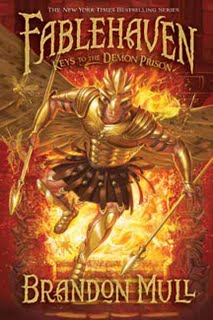
Fablehaven: Keys to the Demon Prison

In March, my family began the epic project of reading out loud the entire Fablehaven series by Brandon Mull.  Sounds like we're some kind of awesome people, doesn't it?  It wasn't intentional at first.  The final book of the series came out in March and my husband bought it the day it came out.  He brought it home and put it on the table to tempt me.  I knew we'd have to do some negotiating about who would get to read it first, but he was going out of town soon, so I figured I could read it first and then he could take it with him when he left town.  Then he suggested we read it out loud to each other so we could enjoy it simultaneously.  I pointed out that he was going out of town and it didn't sound like any fun to be reading it over the phone or webcam.  He teased that he was just going to take it out of town with him anyway and leave me hanging.  Har har.  Then he suggested we read the entire series and then culminate with the fifth book.  I grumbled.  He upped the requirements by suggesting that we read the entire series as a family.  I grumbled some more, but mostly for show because it sounded like fun.  My oldest had read the first book, but no more.  We'd get to enjoy the series again through our kids, which was a worthy project.  I agreed and we began. 

Nearly every evening for more than three months we read.  Mostly it was one chapter at a time but we'd fit in two chapters when we could.  Nobody wanted to miss out so we had our bed full of kiddos while we read.  Good thing we bought a king-sized bed last year or there's no way all six of us would have fit.  My three-year-old would lose patience on occasion, but that wasn't until the later books when the plot got more complex.  We would placate her by reading a stack of picture books before we began.  One of my favorite parts was how my kids would talk about nothing else when an exciting part happened.  Or maybe it's when they would laugh over and over again when Seth was up to his antics.  Or maybe it's when they were absolutely entranced while we read to the point of hypnotism.  Or maybe it's when my oldest would exclaim every single night, "I can't stand cliffhangers!  Please read another chapter!"

By the time we got to the final book, it felt a bit like when the seventh Harry Potter came out.  The anticipation and build up for this culminating event was palpable.  We were all dying to find out what was going to happen.  We went on a trip out of the state at the same time we started it and I read sometimes four chapters a day while we drove or had down time.  When we reached the last ten chapters, I would read sometimes for an hour.  My husband had strep throat so I was doing all the reading.  It was worth it.

I've blogged about this series so many times, I'm not going to bother adding a link here.  Just put in the search box the word "Fablehaven" and see how many posts show up.  There's a bunch.  I have enjoyed this series each step along the way.  My only complaint is that the language some of the adults use seems forced.  Nobody really talks like that unless they're trying to sound intellectual.  On the flip side, Mull has got Seth and Kendra down pat.  He knows exactly how to write a kid's voice.  Plus, Seth and Kendra have a completely believable sibling relationship.  Since they are the focus of the book, it is a treat that he wrote them so perfectly.  And enjoyably.

I don't know exactly what to write about the final book, Keys to the Demon Prison.  If you haven't read any of the previous books, nothing I write would make any sense.  I think you'd have better luck reading previous posts to see if it's the kind of book you'd be interested in for yourself or a kid you know.  I will say that it delivered on every count and that it ended exactly how I hoped it would, but better because Brandon Mull has a better imagination than me.  I will also say that if you like Harry Potter, you'll like Fablehaven.  Harry Potter comparisons get old and are kind of ridiculous, but I'm comparing them in the sense that both series appeal to any age of reader.  Unless you hate fantasy books, which just makes me sad. 

Brandon Mull is coming out with a new series next year called The Beyonders.  I think it's safe to say that we'll be reading it at our house.  We'll have to read Mull's The Candy Shop War in the mean time to sate our need for his amazing writing.

Tuesday, July 6, 2010

The Short Second Life of Bree Tanner

Stephenie Meyer's newest work, The Short Second Life of Bree Tanner: An Eclipse Novella, is a great example of how to milk one success for all it's worth.  Can you imagine any other author being taken seriously with the following pitch?

Meyer: I have this random character who is so obscure and receives so little airtime that if you've only read the original novel once you won't even remember her.  But I'd really like to tell her story.

Publisher: Oh, so you'd like to finish her story for all the fanatic readers who obsess over every little character and wonder what happened next?

Meyer: Well, no.  Because I killed her off at the end of the few pages that she appears in.  So there is no "next." I want to tell her story that led up to her death.

Publisher: You mean, give her personal history so that we understand better how she came to make the choices that led to her tragic end?

Meyer: Sort of.  Actually, I don't care about her personal history that much.  Mostly I'm just going to focus on the couple of days leading up to the death scene.  You know, the scene that readers are already familiar with so they know it won't end well for this character.  And I'll be sure and introduce a lot of new characters too so that the reader is even less invested in what's going on.

Publisher: I see.  And you really think that people are going to buy this novel?

Meyer: Well, it's not a novel exactly.  Really, it's just a teeny little indulgence.  I could easily just publish it online as a treat to my die-hard fans, but why not try to make a few bucks by piggy-backing onto the success of my previous series?  Go with the black, red, and white color scheme and you've pretty much covered my kids' college tuition right there!

Any other author wouldn't be taken seriously, let alone granted a nice hardbound publication of their little pet project.  But any other author wouldn't be Stephenie Meyer, with printing houses falling all over themselves to publish her next work, even if it's just last week's grocery list.  That's not to say that I didn't enjoy reading The Short Second Life of Bree Tanner.  It was short and fast-paced and I can think of worse ways to spend an afternoon.  But I'm afraid Meyer's fame has made her lazy and as long as it's so easy to coast on her previous success, she doesn't have any reason to work at developing her potential as a writer.  (Potential which, while it exists, is still very rough.)

But back to Bree.  We first meet Bree Tanner at the end of Eclipse after the fight between the Cullens and Victoria's army.  Bree is a newborn vampire who apparently doesn't want to fight and surrenders to Carlisle.  But when the Volturi come on the scene, they don't honor the surrender and she is quickly disposed of.  The Short Second Life of Bree Tanner shows us her life in the few days preceding the battle.  We see what it's like to be a newborn vampire and her chaotic and fearful life in the growing army, including more gore than we get in the other books.  And then we see the battle play out from her perspective, offering additional insights into the scene we first saw in Eclipse.  But, you know, it ends the same way.

Because of the brevity and knowing the ending in advance, it was hard to feel very invested in Bree or any of the other characters.  It was interesting to see her as a newborn because I felt like Meyer really shied away from that when Bella became a vampire.  But it was interesting from a "gee whiz" standpoint, not because it really added anything.  And it was kind of hard to feel attached to a character who kills innocent victims and drinks their blood.  Okay, but here's a funny thing.  In all the original novels Edward is referred to as having this unusual bronze-colored hair.  That's one of his defining features, right?  So when Bree starts talking about this redhead at the end, at first I didn't know who she was talking about.  And when I realized it was Edward, I wanted to laugh.  Doesn't Stephenie Meyer know that redheaded males are considered the least attractive people in just about every culture?  Shouldn't she know better than to downgrade her leading man's status like that?  So that was confusing and distracting and just a little bit weird.  I'm really not sure what that was all about.

But there you go.  Another vampire tale, and quite frankly, I'm hoping that she'll try her hand at something else for a while.  No harm in that since we know the publishers will be lining up to print whatever she wants!